
Reviewed · GHENT TOURS
Discover Ghent with a self-guided Outside Escape city game tour!
The best part of this Ghent tour is its story: a deathbed confession may reveal where a missing panel from the famous Lamb of God painting is hidden. You follow clues across the old center, solving puzzles at places such as Vrijdagmarkt, St. Veerleplein, and St. Bavo’s Cathedral.
I like the freedom to start whenever you choose, and I like the small private format. You are not tied to a guide, timetable, or large group. The main caution is value: at $28.66 per group, it can feel pricey if your team needs many hints or expects a polished final explanation.
Key points at a glance

- A missing Lamb of God panel drives the story: The mystery gives the walk a clear purpose instead of turning it into a simple list of sights.
- Seven central Ghent stops fit into about 2.5 kilometers: You see major landmarks without covering a huge distance.
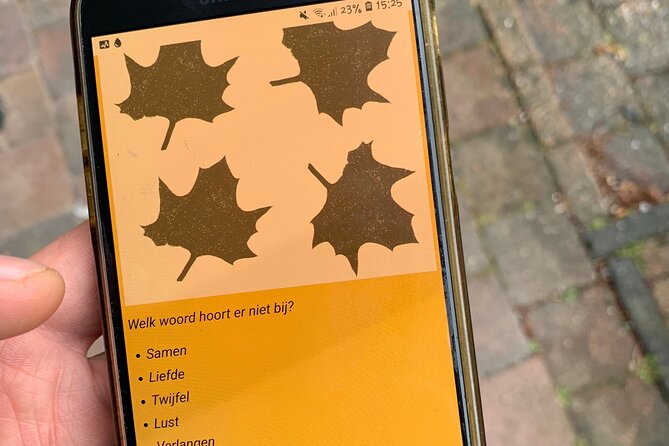
- Your phone is the guide: You need a smartphone and mobile data, but no in-person guide is provided.
- Private play suits small groups: One booking covers up to five people, with the tour information also describing teams of five to six.
- Expect puzzles that can be demanding: Hints may be needed, so this is better for people who enjoy problem-solving than for anyone seeking a relaxed audio tour.
- The finish is at St. Bavo’s Cathedral: The route ends beside one of Ghent’s most important churches, but the final wrap-up may feel abrupt.
A Ghent mystery with a clear purpose
Self-guided city games work best when the game sends you to places you would want to see anyway. This one has a strong reason for moving through central Ghent. The missing panel from The Adoration of the Mystic Lamb, commonly called the Lamb of God, gives the route a local mystery tied to one of the city’s best-known works of art.
You are not simply asked to walk from one clue to the next. The plot asks you to determine if anyone connected to the confession is still alive and knows the panel’s exact location. That question gives your group something to discuss as you move through the streets.
I like this approach for a first or second visit to Ghent. You get a basic orientation to the historic center, but the puzzles make you look more closely at buildings, squares, and details you might otherwise pass without noticing. It also gives teenagers and adults a shared task rather than leaving one person to read every plaque.
The experience is self-guided and private. You choose the starting moment during the stated opening period, then use your own phone to receive directions and solve the challenges. That flexibility is useful if you are fitting Ghent between train connections, meals, or a visit to another attraction.
There is a tradeoff. A live guide can adjust the pace, explain a confusing clue, and add local stories on the spot. Here, the phone gives you the information, and your group must work out the answers. That is part of the fun, but it also means the experience can become frustrating if the puzzles do not suit your group.
More Self-Guided Trails in Ghent
- e-Scavenger hunt Ghent: Explore the city at your own pace
★ 4.5 · 41 reviews - Discover Ostend while playing! Escape game – The Walter case
★ 4.0 · 16 reviews - e-Scavenger hunt Kortrijk: Explore the city at your own pace
★ 4.5 · 15 reviews
Vrijdagmarkt begins the route

The starting point is Vrijdagmarkt, one of Ghent’s oldest squares. It covers about one hectare and has played an important role in the city’s public life.
This is a sensible place to begin because it gives you room to gather, check your phone, and divide up the puzzle-solving duties. I would arrive with your phone charged and your mobile data ready before you begin. The tour is meant to start at a time you choose, so there is no need to rush to a guide’s meeting time.
Plan roughly 20 minutes here. The game will direct your attention toward the square and its surroundings, while the open setting gives you space to compare clues with your teammates. If your group includes different ages or levels of patience, this first stop will quickly show you how demanding the puzzles are.
The route is designed for participants aged 15 and older. Younger players can take part with supervision, but the story and puzzle level are aimed more at teens and adults than at small children.
St. Veerleplein and the Gravensteen setting
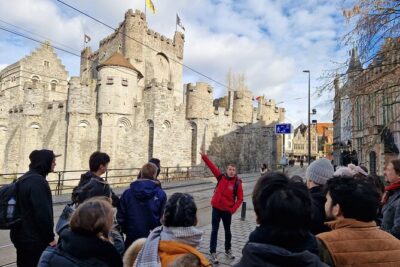
Next comes St. Veerleplein, a square dominated on its north side by the Gravensteen, Ghent’s well-known castle. The Lieve runs behind the buildings to the west, while the Leie lies to the south. The Patershol district is to the east.
This stop packs several pieces of Ghent’s urban character into one place: water, an imposing castle, and an old neighborhood of narrow streets. You will spend about 20 minutes here, so take time to orient yourself rather than racing straight to the next answer.
The square is named for Saint Pharaïldis of Ghent. That detail is typical of the route, which uses notable places to add context to the game. You are not visiting the interior of the castle as part of this experience, so do not book this expecting a guided castle tour or admission to an attraction.
I like this stop because the setting makes the mystery feel more physical. A clue connected to a castle, river, and old quarter has more atmosphere than one delivered on an ordinary modern street. At the same time, busy public spaces can make concentration harder, especially when several teams or groups are nearby.
Sint-Niklaaskerk brings Gothic detail into play
The route then leads to Sint-Niklaaskerk, dedicated to Nicholas of Myra. The church is a strong example of Scheldt Gothic architecture, a style associated with the region.
Its most distinctive feature is the crossing tower, also described as a lantern tower. It brings light into the transept and the flying buttresses around the main choir. The tower reaches 76 meters, making it an easy landmark to identify as you work through the city center.
Again, allow about 20 minutes. The game may have you examine the church and its surroundings as part of a puzzle, but this is not a formal church tour. If you are interested in architecture, you may want to give the building a little extra attention beyond the time needed for the challenge.
For me, this is where the route’s sightseeing value becomes clear. Even if your group does not solve every puzzle quickly, you are being sent to a major Ghent landmark. The game gives you a reason to pause and look up.
Same city, a completely different way to spend a day:
- Ghent: 50-Minute Medieval Center Guided Boat Trip
★ 4.5 · 5,637 reviews - Historical Walking Tour: Legends of Gent
★ 5.0 · 1,761 reviews - Ghent: 40 Minute Medieval Center Guided Boat Tour
★ 4.4 · 884 reviews - Evening Tour of the Dark Side of Gent
★ 5.0 · 646 reviews
Stadshal shows modern Ghent beside the old center
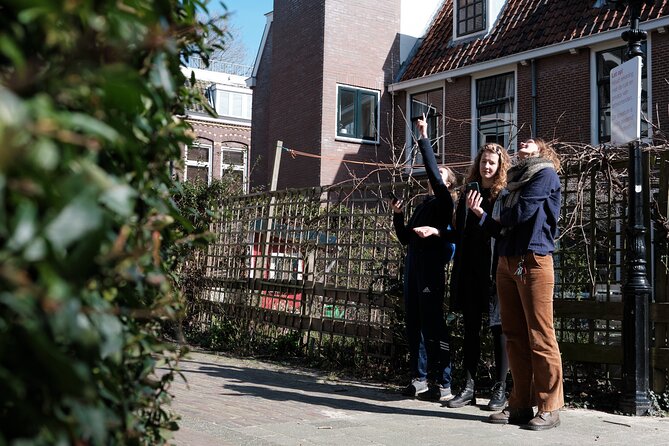
Stadshal is a large open canopy on Emile Braunplein. It forms part of the KoBra urban development project in the historic center.
This stop provides a change of mood. The route is not limited to medieval façades and churches. Stadshal is a modern civic structure, and its open design contrasts with the older buildings around it.
You will spend about 20 minutes here. The space should be easy to find, but the open canopy can feel less intimate than the earlier squares. That contrast is useful: Ghent is not a preserved stage set, and the city has added new public architecture within its old core.
The puzzle here may appeal to people who enjoy using physical surroundings as part of a game. If you prefer a traditional sightseeing walk with a guide explaining dates and design choices, this stop will feel lighter on formal interpretation. Its role is to support the game and keep the route moving.
Geeraard de Duivelsteen adds a darker note
Geeraard de Duivelsteen, or the Castle of Gerald the Devil, is one of the route’s more atmospheric stops. The building played an important part in defending the Portus aan de Reep, a trading settlement linked to Ghent’s early development.
The name alone fits a mystery involving a confession and a missing artwork. You get another 20-minute puzzle segment here, with the building’s defensive role adding weight to the story.
I would pay attention to how the route uses different kinds of places. Some stops are grand churches or civic spaces. This one connects the city to trade and defense, giving you a wider sense of how Ghent developed. The tour does not claim to replace a full historical tour, but it does give your walk several useful anchors.
As with the other stops, the admission cost is free because the experience takes place along the public route. That does not mean every nearby attraction is included. You are paying for access to the self-guided game, not entrance to buildings along the way.
The Sint-Lievenscollege and Baudelo stop
The next location is identified as Sint-Lievenscollege Business campus Baudelo. The information for this stop also points to the Bishop’s Palace of Ghent, located on Bisdomplein. The palace serves as the administrative seat of the Diocese of Ghent and the bishop’s residence, and it is protected as a monument.
This part of the route shifts attention toward religious administration and civic architecture. After churches and defensive buildings, you see how the city’s religious institutions occupy another role in Ghent’s center.
Allow about 20 minutes. Because the stop includes more than one associated name, you should rely on the instructions in the mobile game to identify exactly where to stand and what to inspect. This is one reason a working phone and mobile data matter.
The route’s short walking distance helps here. The full tour is about 2.5 kilometers, so you are not spending most of the experience marching between far-flung points. The time goes into solving clues and looking around, not simply covering ground.
St. Bavo’s Cathedral provides the final landmark
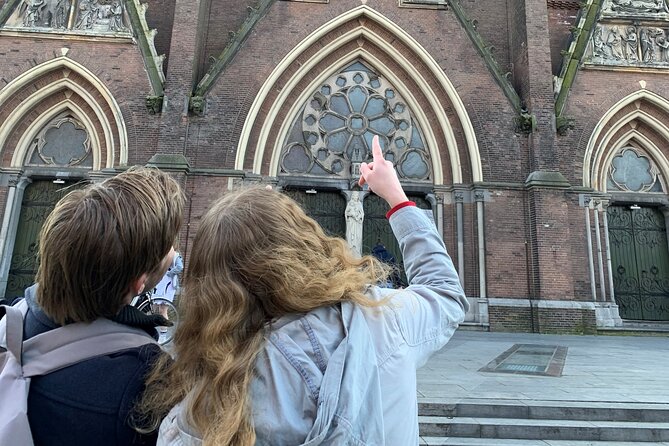
The route ends at St. Bavo’s Cathedral on Sint-Baafsplein. This is a fitting destination for a mystery connected to the Lamb of God, since the cathedral is associated with the famous painting.
The church began as a parish church dedicated to John the Baptist. In 942, Transmar, bishop of Tournai, consecrated it as Sint-Janskerk. Those details give the final stop an early historical foundation, even if the game itself keeps your attention on the mystery.
Plan another 20 minutes here. The stated end point is at the cathedral, not necessarily a guided visit inside. If you want to see the cathedral or the artwork beyond the game, check its separate visiting arrangements rather than assuming admission is included.
The ending deserves a practical warning. The final puzzle may arrive without much closing text or a long explanation of what happened. If your group enjoys a neatly packaged story, this could feel sudden. I would treat the game as a puzzle walk that finishes at a major sight, then allow extra time to continue exploring Ghent on your own.
How the price works for a small group
The price is $28.66 per group of up to five people. That is not a per-person charge, so the value improves sharply when four or five people share the booking. At five players, the cost works out to about $5.73 each before any currency conversion or booking charges.
For two people, the same price feels less attractive. You are paying for a private activity with flexible timing and a route through seven central locations, but you are also supplying the phone, data connection, and all the puzzle-solving effort.
The value depends on what you want from a city tour. I think the price is easier to justify if your group enjoys escape-room games, clue hunts, and playful sightseeing. It is harder to justify if you mainly want clear historical explanations from a local guide.
The available rating is 4.2 from 10 reviews, which suggests a generally positive but not flawless experience. The most important criticism concerns price compared with the content, difficult puzzles that required frequent hints, and an ending that felt too sudden. Take those points seriously when deciding.
Timing, phones, and group size
The activity takes about 1.5 to 2.5 hours, with two hours given as the usual duration. The seven stops are each planned for about 20 minutes, and the walking route covers approximately 2.5 kilometers.
That pace is manageable for most people who can walk through a city center. Still, allow extra time if your group pauses for photos, needs hints, or stops to examine the churches and squares properly. I would avoid scheduling a tight connection immediately afterward.
You need a smartphone with a mobile data plan. Since the tour is self-guided, the phone is not a minor convenience. It is your route, puzzle interface, and source of instructions. Bring a charged device, and consider having a second phone available if your group is large enough to split clue-reading duties.
The ideal team is three to five people aged 15 and older. One person can read the instructions while others inspect the surroundings, but a larger group may find it easier to exchange ideas. The information also describes teams of five to six players, so check the booking setup if you plan to bring six.
The activity is private, meaning only your group takes part. That is a real advantage if you want to move at your own speed or avoid strangers joining your puzzle. Service animals are allowed, the route is near public transportation, and most people can participate.
Who should book this Ghent game?
I would choose this for friends, families with older teenagers, and couples who enjoy turning sightseeing into a task. It is also a useful option if your schedules do not line up with a fixed walking tour.
You should book it if you like:
- Solving clues in public places
- Learning about major sights while following a story
- Exploring without a guide
- Sharing one group price
- Setting your own start time
I would choose another kind of tour if you want detailed commentary at every stop, guaranteed help with each puzzle, or a carefully narrated ending. The game is designed to make you work things out. That can be rewarding, but it is not the same as having a local expert explain every building.
Before starting, agree on a group rule for hints. You might give yourselves a set amount of time on each clue, then use a hint rather than letting one difficult answer stall the entire walk. That small plan can make the experience feel more like a game and less like a test.
Cancellation and practical planning
You can cancel for a full refund up to 24 hours before the scheduled start time. Cancellations or changes made within 24 hours are not accepted for a refund, and the cut-off follows local time in Ghent.
The stated operating period runs from July 12, 2023, through June 17, 2026, with hours listed daily from 7:00 AM to 11:00 PM. Confirmation is sent at booking, so check the details before setting off.
I would start during daylight if you want to examine the churches, squares, and buildings comfortably. The listed hours allow evening play, but the quality of a clue that depends on seeing architectural details may vary after dark. That is practical planning rather than a restriction stated by the operator, so use your judgment.
Should you book the Outside Escape Ghent tour?
Book it if you want a flexible, private walk with a solid mystery hook and a route that connects seven important central sights. The missing Lamb of God panel gives the game more character than a generic city scavenger hunt, and the 2.5-kilometer route is a reasonable way to get oriented.
Skip it if you mainly want a guide-led history lesson or dislike asking for hints. The puzzles can be difficult, the ending may feel abrupt, and the price is best shared among a full group.
For five players aged 15 and older, I think the math works well. You get about two hours of shared entertainment for a modest per-person cost, plus a useful introduction to central Ghent. For one or two people, compare it with a traditional walking tour before booking.
FAQ
Where does the Ghent city game start?
The activity starts at Vrijdagmarkt in Ghent, Belgium.
Where does the route end?
The route ends at St. Bavo’s Cathedral, Sint-Baafsplein 1, 9000 Ghent.
How long does the experience take?
It takes approximately 1.5 to 2.5 hours, with about two hours being the usual duration.
How far do you walk?
The route is approximately 2.5 kilometers long.
How many people can join one group?
The price covers a group of up to five people. The activity information also describes teams of five to six players, so confirm the maximum when booking for six.
What equipment do I need?
You need a smartphone with a mobile data plan. The experience uses a mobile ticket and is self-guided.
What is the cancellation policy?
You can cancel at least 24 hours before the start time for a full refund. Cancellations or changes made less than 24 hours before the start time are not refunded.
Just added around Ghent
- Ghent Running and Sightseeing Tour★ 5.0 · 3 reviews
- Ghent Walking Tour – City Highlights and Beyond Tradition★ 4.5 · 3 reviews
- Ghent: Walking Tour from Friday Market to the Cathedral★ 4.8 · 3 reviews
- Ghent: City Walk with Audio Guide in 7 Languages on your Phone★ 4.5 · 3 reviews
- Children’s escape game in the city of Ghent Marsupilami★ 5.0 · 3 reviews
- Discover Ghent while playing! Escape game – The Walter case★ 4.5 · 4 reviews
- Discover Ghent while playing! Escape game – The alchemist★ 4.0 · 4 reviews
- e-Scavenger hunt Mons: Explore the city at your own pace★ 5.0 · 4 reviews
Ghent Tours, compared.


Browse the lists this tour appears in