
Reviewed · GHENT TOURS
Ghent Running and Sightseeing Tour
Ghent is at its best before the crowds arrive, and this tour uses a gentle jog to take you farther than a standard walking route. You move from the Opera and Kouter to the medieval quays, Portus Ganda, Graffiti Street, and the city’s famous towers, with regular stops for stories and photos. I like the early-morning feel and the way the tour reaches beyond the usual centre. I also like that the guide adjusts the pace instead of treating the outing as a race.
The main thing to weigh is the format: 45 minutes is enough for a useful first look, not a full tour of Ghent. You need sports shoes and sportswear, and the activity is not suitable for children under 18, pregnant women, people with mobility or back problems, or those with pre-existing medical conditions.
Key points at a glance
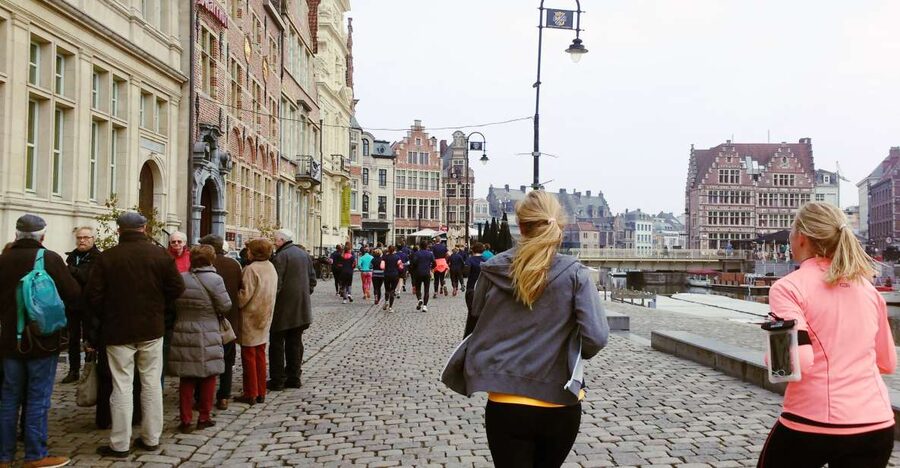
- A sightseeing jog, not a competition: The guide sets a leisurely pace and adjusts it to the group.
- A wider route than a walking tour: You see the centre, the medieval quays, Portus Ganda, Graffiti Street, and other quarters.
- Three famous towers included: St. Bavo Cathedral, the Ghent Belfry, and St. Nicholas Church feature along the route.
- An early start with a different mood: You see Ghent waking up before the streets fill.
- A short but active introduction: The 45-minute tour combines exercise, history, and photo stops.
- English guidance with local context: A personal guide explains Ghent’s past and the role of places such as the Opera and Handelsbeurs.
Why a running tour works well in Ghent
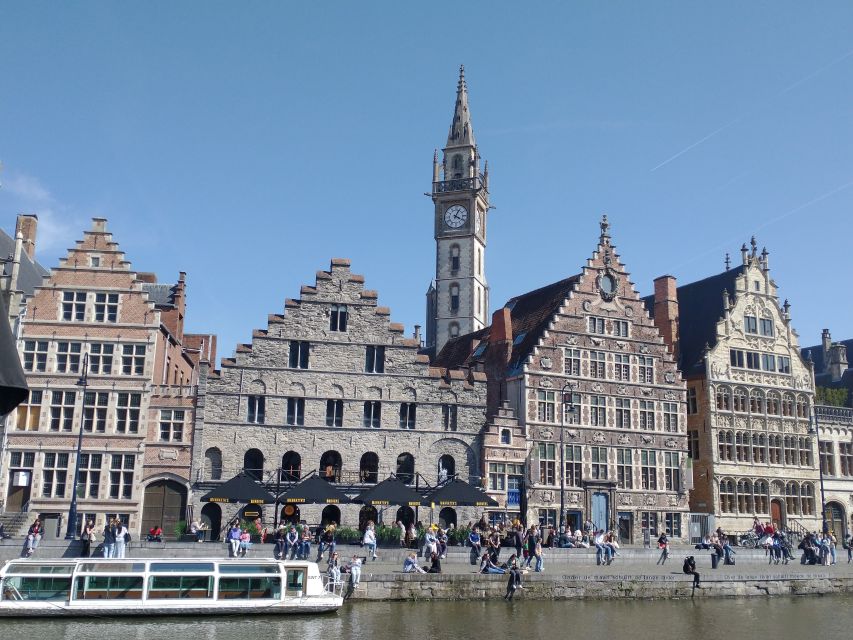
Ghent’s centre is compact enough to explore on foot, but a run lets you connect more pieces of the city in a short time. You are not rushing from one sight to the next. Instead, you jog between stops, pause for an explanation, then continue once the group is ready.
That format suits you if you want an overview before spending the rest of the day on your own. It also gives you a quick sense of how the historic centre relates to areas beyond the postcard views. A walking tour may concentrate mainly on the most famous lanes and squares. This route makes room for the wider story.
The pace is intended to be easy. One booking recorded roughly 6 kilometres, with the guide adapting the distance and speed to the group. That figure should not be treated as a fixed promise, since the route can respond to the people taking part and the conditions on the day. Still, it gives you a useful idea: this is a real jog with sightseeing stops, not a brief stroll with a few running steps.
You should be comfortable moving at a gentle running pace for the full 45 minutes. The guide does not present it as a fitness challenge, but sports shoes and sportswear are still essential. Bring water, since a bottle is recommended and not supplied.
A few more Ghent half-days to weigh up
- Ghent: 50-Minute Medieval Center Guided Boat Trip
★ 4.5 · 5,637 reviews - Historical Walking Tour: Legends of Gent
★ 5.0 · 1,761 reviews - Ghent: 40 Minute Medieval Center Guided Boat Tour
★ 4.4 · 884 reviews
Meeting at the Opera and Kouter
The tour begins outside the main entrance of the Ghent Opera, near Kouter. This is a practical central meeting point, and the Opera itself becomes part of the introduction. Your guide welcomes you, gives a short warm-up, and explains how the run will work.
Kouter is more than a place to gather. The square has a connection with Ghent’s World Expo story, giving the guide a chance to show how the city’s public spaces have served different purposes over time. You start with a modern and civic side of Ghent before moving toward the older core.
The warm-up matters, even on a short tour. It sets the tone and gives you a moment to check your shoes, clothing, and pace before leaving the square. If you are joining early in the morning, this is also a useful chance to get oriented before the city becomes busier.
The Opera and nearby Handelsbeurs add another layer. The tour does not simply point at a landmark and move on. It uses these buildings to explain how culture, commerce, and public life fit into Ghent’s story. You get more from the stop if you listen for the connection between the building and the surrounding quarter.
Medieval trade along Korenlei and Graslei
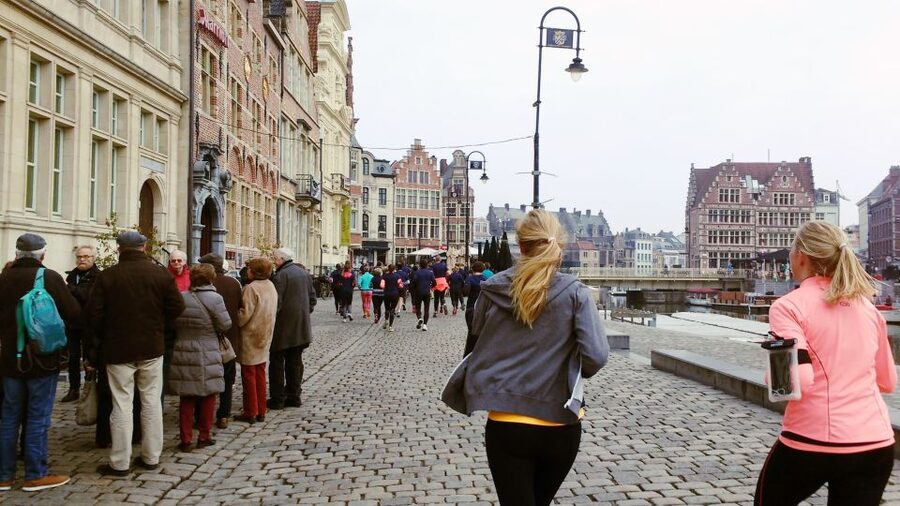
From the opening square, the route heads toward Korenlei and Graslei, two of Ghent’s best-known waterfront streets. Their appeal is obvious: historic buildings line the water, and the quays offer some of the city’s clearest views.
The guide places these streets in their medieval trading context. That makes the view more useful than a simple photo stop. You learn why this stretch mattered to the city and how trade helped shape Ghent’s importance.
The morning timing is especially helpful here. Korenlei and Graslei can become busy later in the day, while an early run gives you a quieter look at the facades and water. You may still encounter other people, but the experience is designed around seeing the city before it fully wakes up.
You stop rather than run continuously, so you have time to look around and hear the explanation. Still, remember that the tour keeps moving. If you want detailed architectural study, long photography sessions, or time inside buildings, save those for a separate visit.
Portus Ganda and the beginnings of Ghent
The route continues to Portus Ganda, a key point in the city’s origin story. The name refers to the meeting of waterways associated with the birth of Ghent, and the stop helps connect the modern city to its earliest development.
This is one of the tour’s most useful additions because it takes you beyond the most familiar central views. Korenlei and Graslei show you Ghent as a medieval trading city. Portus Ganda helps explain why a settlement formed here in the first place.
You do not get a long lecture. The tour is built around short explanations during a physical outing, so the information stays focused. That is good for a first visit, although anyone seeking a detailed historical study will need more time elsewhere.
The route also gives you a change of setting. Rather than looking at one historic quarter throughout, you see how different parts of Ghent relate to one another. That wider view is a central reason to choose a running tour over a compact walking route.
Same city, a completely different way to spend a day:
- Evening Tour of the Dark Side of Gent
★ 5.0 · 646 reviews - Ghent Bike Tour Off-the-beaten-track
★ 5.0 · 505 reviews - Ghent: 40-Minute Historical Boat Tour of City Center
★ 4.3 · 430 reviews - Ghent: Guided Urban Bike Tour
★ 4.9 · 297 reviews
Graffiti Street and a planned photo stop
Graffiti Street brings a different visual note. The route takes you through this popular lane and includes a stop for photos. It is a good reminder that Ghent is not only about medieval stone, churches, and grand civic buildings.
The stop is practical as well as entertaining. A running tour can make photography awkward if you are always moving. Here, you have a clear pause to take pictures, catch your breath, and enjoy the changing walls.
Graffiti Street also helps break up the historical sequence. After hearing about medieval trade and the city’s origins, you see a living, changing part of Ghent’s public culture. The route does not require you to choose between old Ghent and newer expressions of the city. It puts both in the same short circuit.
You should not expect a guided art lecture, since the stated focus is sightseeing and Ghent’s history. Think of this as a well-placed visual stop and a chance to make a few memorable pictures.
Ghent’s three towers in one active route
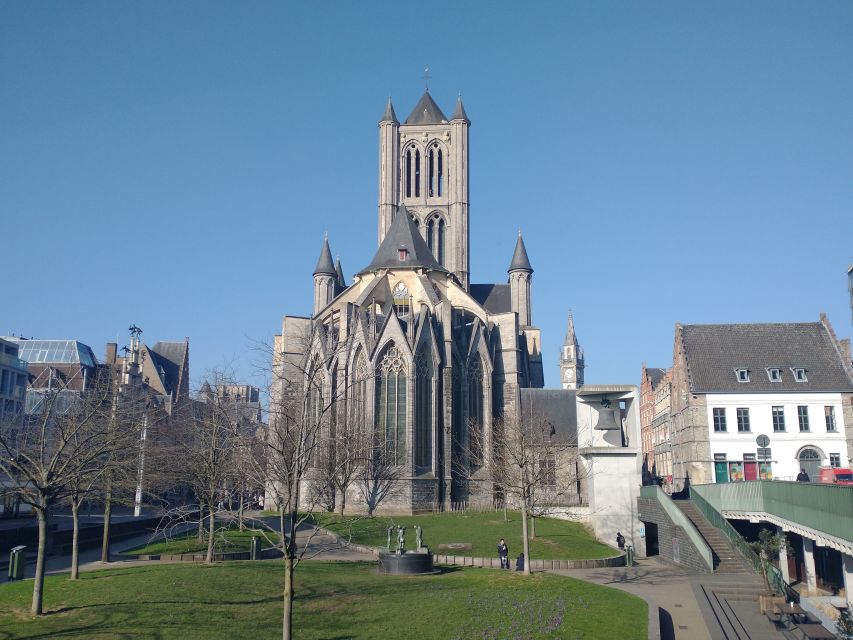
The tour includes St. Bavo Cathedral, the Ghent Belfry, and St. Nicholas Church, the three famous towers that define the central skyline. Seeing all three during a 45-minute route gives you a strong visual framework for the city.
St. Bavo Cathedral is one of the key landmarks in the historic centre. The Belfry represents Ghent’s civic identity, while St. Nicholas Church adds another major medieval church to the line-up. From the outside, the three buildings help you understand the shape and scale of the old city.
The guide stops to explain them rather than asking you to admire them while running past. That balance is important. You get the basic story and a chance to take in the details, but the schedule does not allow a full visit inside any of these buildings.
If you already plan to tour the cathedral, climb the Belfry, or enter St. Nicholas Church, this outing works well as an introduction. It gives you context first, then leaves you free to return later with more time. If your main goal is interior art or tower views, book separate time for those visits.
Beyond the postcard centre
One of the strongest reasons to book this tour is the promise of going beyond the standard tourist route. You still see the central landmarks, but the run also introduces different quarters and places such as the Opera and Handelsbeurs.
That wider coverage helps you understand Ghent as a working city rather than a collection of historic photographs. You notice how the grand centre connects with other districts and how culture, trade, public spaces, and older waterways overlap.
The short format makes this especially useful on a first morning in town. You can use the route to decide where to return later. Perhaps the quays deserve a longer walk, or Portus Ganda deserves a slower look. Maybe you want to revisit Graffiti Street when you are not carrying a phone while jogging.
The tradeoff is depth. You cover a lot of ground, but each stop receives a concise explanation. I would choose this tour for orientation and atmosphere, not as your only history lesson in Ghent.
What the guide adds to the experience
You have a personal local guide rather than an audio track. That means the pace can respond to the group, and stops can be adjusted to the day’s conditions. The information is delivered in English.
The guide’s role is part historian, part route leader, and part pace setter. You need all three on this type of outing. A guide who talks too long can turn a run into a standing tour. A guide who focuses only on speed can leave you with little sense of place. The stated format aims for a middle ground.
Sophie led one private booking and was able to adapt the tour to the particular conditions of the day. You should not assume Sophie will lead every departure, but her involvement shows the kind of personal approach the provider can offer.
The pace is the most important service the guide provides. A Dutch booking described the run as very accessible, with the group’s speed adjusted well. That is encouraging if you jog for sightseeing rather than exercise. Even so, you should be honest about your comfort level before booking, since the activity remains a run and not a walking tour.
Is $53 a fair price for 45 minutes?
At $53 per person, this is not the cheapest way to see Ghent. You are paying for a personal English-language guide, a planned route, local history, photo opportunities, and the chance to cover more ground than a walking tour in the same time.
The value depends on what you want from the morning. If you enjoy running and would otherwise explore independently, the price buys structure and company rather than access to a ticketed monument. There are no entry fees or transport services included, and you need to bring your own water and snacks.
I see the strongest value for a first-time visitor with a limited schedule. In 45 minutes, you can get a broad introduction, learn the layout of the centre, and identify places to revisit. The cost is harder to justify if you want a long, detailed history talk or a slow architectural walk.
The small number of published ratings is also worth noting. The score is 5 out of 5 from three ratings, including praise for the adjustable pace, sightseeing, and the guide’s ability to adapt. That is a positive sign, but it is not a large sample. I would treat the excellent score as encouraging rather than as a guarantee that every group will have the same experience.
Who should book this Ghent run?
I would recommend it to an adult who likes light exercise, wants an early start, and prefers an active overview to a standard walking tour. It is a good match if you want to see both famous landmarks and less obvious parts of the city without committing to a long run.
It also suits repeat visitors who have already seen the main sights and want a different way to connect them. The route’s mix of quays, waterways, towers, public buildings, and Graffiti Street keeps it from feeling like a simple checklist.
You should choose another format if you have mobility limitations, back problems, a pre-existing medical condition, or cannot comfortably jog. The activity is not suitable for pregnant women or children under 18. It is also a poor match if you want to smoke during the tour, record the audio, or spend extended time inside the landmarks.
Wear proper sports shoes and sportswear. Carry water, and keep your passport or ID card with you, as Belgian law requires you to have identification on hand even though you do not need to show it to the guide.
Book this tour or walk Ghent on your own?
Book the Ghent Running and Sightseeing Tour if you want a brisk, friendly start with a local guide, regular history stops, and a route that reaches beyond the usual centre. The early timing, adjustable pace, Graffiti Street photo stop, and coverage of all three towers make it a useful first look at the city.
Skip it if 45 minutes feels too short, or if you want interiors, lengthy explanations, or a purely relaxed walk. At $53, the price makes the most sense when the combination of exercise, orientation, and personal guiding is exactly what you want. Free cancellation up to 24 hours before the activity and the reserve-now, pay-later option make it easier to fit into a changing itinerary.
FAQ
Where does the Ghent running tour begin?
The meeting point is outside the main entrance of the Ghent Opera, near Kouter.
How long does the tour last?
The tour lasts 45 minutes.
What language is the tour in?
The live tour guide provides the experience in English.
Is this a competitive race?
No. It is a leisurely run or jog for sightseeing rather than a competition, and the pace is adjusted to the group.
How far will I run?
The advertised duration is 45 minutes. One booking covered about 6 kilometres, but the guide can adjust the pace and route to the group.
Which landmarks are included?
The route includes Kouter, Korenlei, Graslei, Portus Ganda, Graffiti Street, St. Bavo Cathedral, the Ghent Belfry, St. Nicholas Church, the Opera, Handelsbeurs, and different quarters of Ghent.
What should I bring?
Bring a passport or ID card, sports shoes, and sportswear. A bottle of water is recommended, and water is not included.
Who should not take this activity?
The tour is not suitable for pregnant women, people with back problems, people with mobility impairments, children under 18, or people with pre-existing medical conditions.
Can I cancel or pay later?
You can cancel up to 24 hours in advance for a full refund. You can also reserve your place and pay later, so you do not need to pay anything at the time of booking.
Just added around Ghent
- Ghent Walking Tour – City Highlights and Beyond Tradition★ 4.5 · 3 reviews
- Ghent: Walking Tour from Friday Market to the Cathedral★ 4.8 · 3 reviews
- Ghent: City Walk with Audio Guide in 7 Languages on your Phone★ 4.5 · 3 reviews
- Children’s escape game in the city of Ghent Marsupilami★ 5.0 · 3 reviews
- Discover Ghent while playing! Escape game – The Walter case★ 4.5 · 4 reviews
- Discover Ghent while playing! Escape game – The alchemist★ 4.0 · 4 reviews
- e-Scavenger hunt Mons: Explore the city at your own pace★ 5.0 · 4 reviews
- Ghent: Guided City Highlights Walking Tour with Light Meal★ 4.6 · 5 reviews
Ghent Tours, compared.
Browse the lists this tour appears in