

Reviewed · GHENT TOURS
e-Scavenger hunt Kortrijk: Explore the city at your own pace
Kortrijk turns sightseeing into a team game with this self-guided smartphone hunt. You follow clues, answer questions, and move between medieval towers, old courtyards, churches, museums, and shopping streets. It is less formal than a guided walk, but it gives you a reason to look closely at details you might otherwise pass.
I like the freedom to stop for coffee, take a wrong turn, or pause at a museum without holding up a guide. I also like the price: $37.33 covers a private group of up to six, making it good value for families or friends. The main caution is that the GPS and navigation have not always worked smoothly, and construction work can hide the details needed for some answers.
Key points before you book

- Private game for up to six people: One booking covers your whole group, so the per-person cost drops sharply when you fill the team.
- A broad look at Kortrijk: The route links the Beguinage, Belfry, Broel Towers, churches, museums, parks, and shopping areas.
- Two to four hours on foot: You set the pace and decide when to stop, but the number of locations can make this a full city walk.
- History with a playful edge: Questions about counts, statues, battles, and buildings turn passive sightseeing into a shared challenge.
- Bring your own phone and data: The app is included, but the smartphone and mobile internet are not.
- Best for independent explorers: You will not have a guide explaining each stop, so the experience suits people who enjoy finding answers for themselves.
Starting at Kortrijk station and finding your bearings
The trail begins at Stationsplein 6, 8500 Kortrijk, near the railway station, and finishes back at the same meeting point. That is useful if you arrive by train and want an activity that begins without extra local transport.
The experience is available every day around the clock within the stated operating period. You can begin at a time that fits your day, although you should allow at least two hours and perhaps four if you stop often or take your time with the questions.
The app provides the game, navigation, and assignments. You need your own smartphone and data connection. Before starting, I would make sure your phone is charged, location services are enabled, and the app has the access it needs. One technical problem can change the mood of a game quickly, so it is sensible to have Google Maps available as a backup.
This is not a guide-led walk. No one meets you to explain Kortrijk in person, and there is no fixed group schedule. That gives you privacy and flexibility, but it also means the app has to do the work. If you prefer a clear spoken story and a guide who can answer questions, choose a traditional walking tour instead.
More Self-Guided Trails in Ghent
- e-Scavenger hunt Ghent: Explore the city at your own pace
★ 4.5 · 41 reviews - Discover Ostend while playing! Escape game – The Walter case
★ 4.0 · 16 reviews - Ghent Walking Tour with Audioguide on Your Smartphone
★ 4.5 · 13 reviews
The Beguinage: small houses and a complicated past
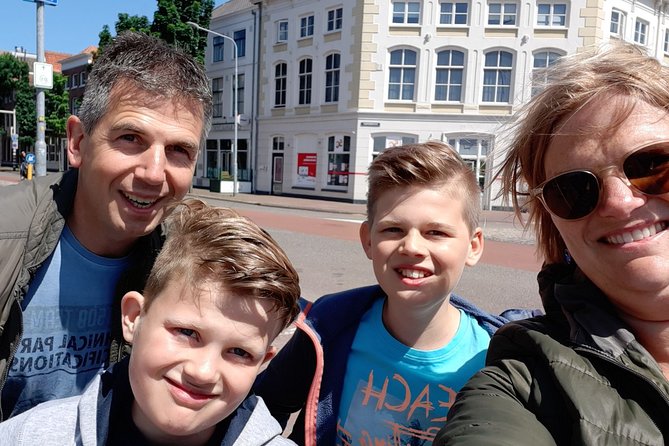
The Kortrijk Beguinage is one of the strongest early stops. It dates from the 13th century and has been a UNESCO World Heritage Site since 1998. Its small houses and enclosed courtyard give you a close look at the quiet, inward-facing world of the beguines.
You can stroll past the cottages and visit the courtyard or the Mattheuskapel. The setting rewards slow looking. This is not a grand square built to impress from a distance. It is a compact place where scale matters: narrow paths, modest homes, and a more private atmosphere.
The game also draws attention to the Beguinage’s difficult past. It was destroyed several times, including during the Battle of the Golden Spurs in 1302, after the Battle of Westrozebeke in 1382, and again by the French in 1684. The 41 cottages you see today date from the 17th century, giving the site a layered story rather than a single date.
Nearby, Kortrijk 1302 is housed in the former Groeninge Abbey in Beguinage Park. This multimedia museum explores the way the Battle of the Golden Spurs became part of Kortrijk’s public memory. If it is open and you have time, it gives useful context for the monuments and symbols you encounter later.
Broel Towers and the Lys connection
The Broel Towers offer one of the city’s most recognizable views. Built from limestone and sandstone, the towers guard the Lys and recall Kortrijk’s military and trading past.
The southern Speytorre dates to 1385 and was used to control traffic on the river. That detail makes the towers more than a photogenic pair of stone buildings. Their position tells you how closely water, commerce, and defense were tied together.
This is a good place to pause and take in the setting before answering the app’s question. Self-guided games work best when you do not rush from marker to marker. Look at the stonework, the river, and the relationship between the two towers. The route gives you the prompt, but you provide the attention.
Churches that mark Kortrijk’s long timeline
Several churches help build the city’s religious and architectural story. The Church of Our Lady began in 1199 on the initiative of Count Baldwin IX and was located within the grave domain of Kortrijk. Even if you only see it from outside, its early foundation places it among the city’s oldest major landmarks.
St. Martin’s Church has an even earlier spiritual footprint. The site already held a place of worship around 650 AD. The present church gives you one of the route’s most familiar city views, and its long timeline makes it a useful reminder that Kortrijk was not created in one period.
The Passionists’ church, built in 1874, offers a different mood. It is described as an archetypal church of popular devotion, so it adds a 19th-century religious stop to a route otherwise filled with medieval references.
The route also points to the building whose facade carries 14 statues of the counts of Flanders. Its architecture shows the transition between Gothic and Renaissance styles. This is precisely the kind of detail that a scavenger hunt can make memorable. Instead of simply walking past a facade, you have a reason to count, compare, and inspect.
Same city, a completely different way to spend a day:
- Ghent: 50-Minute Medieval Center Guided Boat Trip
★ 4.5 · 5,637 reviews - Historical Walking Tour: Legends of Gent
★ 5.0 · 1,761 reviews - Ghent: 40 Minute Medieval Center Guided Boat Tour
★ 4.4 · 884 reviews - Evening Tour of the Dark Side of Gent
★ 5.0 · 646 reviews
Belfry, cloth trade, and the city center
Kortrijk’s Belfry rises from the Grote Markt and was once part of the former cloth hall. The earliest mention of that cloth hall dates to 1248. The tower is therefore tied to the city’s commercial life, not just its civic identity.
This stop is especially suited to a question-based game because the market square gives you visible clues. You can study the tower, look across the square, and connect the building to the trade that helped shape Kortrijk.
The route also brings you to K in Kortrijk, a central shopping center with more than 80 shops and restaurants spread across 34,000 square meters. That may seem less historic than the Belfry, but it gives the walk a modern counterpoint and a practical place for a break.
Ring Shopping, on the outskirts of Kortrijk, adds another commercial stop with about 90 shops. This is one part of the experience to consider carefully. If your main goal is medieval architecture, shopping centers may feel like a detour. If you want a broad look at present-day Kortrijk, they show how the city serves local daily life beyond its historic core.
Baggaertshof and the value of smaller stops
Baggaertshof was founded in 1638 by Joossine Baggaert, who established 13 cottages for women in need. The site gives the route a social dimension. Kortrijk’s story is not only about counts, battles, churches, and trade. It also includes charitable housing and the practical care of vulnerable people.
The hospital courtyard offers another quieter stop. It is one of the best-preserved 17th-century sites in Kortrijk. The word hospital originally referred to hospitality, not illness, which adds a useful twist to the place. You begin to see how older civic buildings often combined shelter, care, religion, and community duties.
These smaller locations are where the format earns its keep. A normal highlight walk might focus only on the Belfry and churches. The questions lead you toward places that can be easy to miss, giving you a fuller sense of the city’s scale.
Battle memorials and the city’s public memory
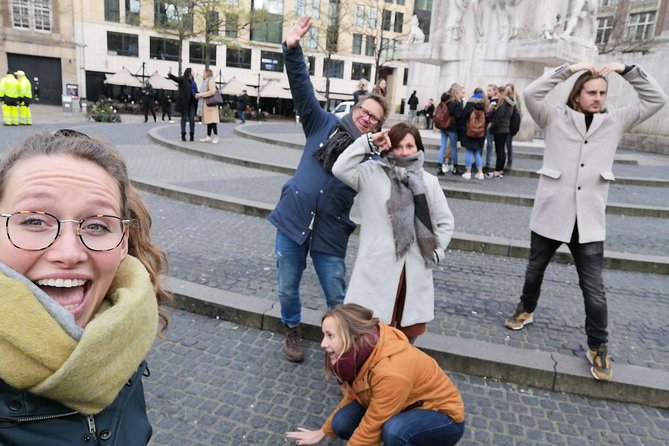
Kortrijk repeatedly returns to the Battle of the Golden Spurs. The Groeningepoort is a memorial triumphal arch built for the battle’s 600th anniversary. The Groeninge Gate and Groeninge monument were constructed to commemorate the same event.
The Kortrijk 1302 museum examines how the battle became a myth-making subject. Seeing the museum alongside the memorials helps you separate the event itself from the later ways it was remembered and celebrated.
A question in this area may ask you to count or identify statues. Pay close attention to the wording. One player found a question about the Flemish counts unclear because a statue of Mary was included in the count. The lesson is simple: read each clue closely, and do not assume that every figure on a facade belongs to the same group.
This section is also where the game can become competitive. Two teams can compare answers and scores, adding a friendly contest to the walk. With one group of up to six, you can divide into pairs or work together, though the supplied experience is designed for one private team.
Military remains and the Kortrijk Theatre
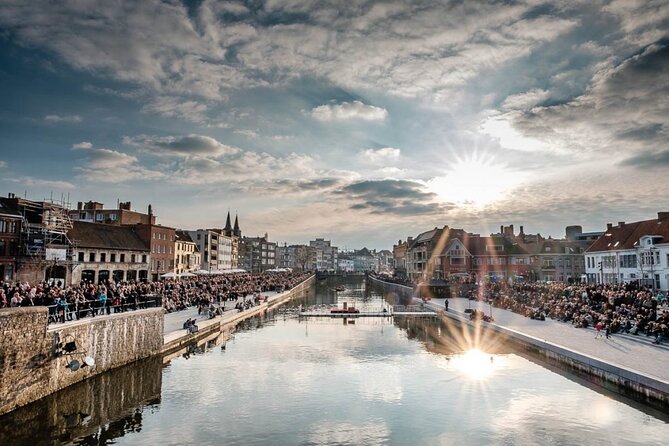
The Artillery Tower, also called the Armorie Tower, dates from the construction of the castle in 1301 and 1302. It was built by the French King Philip the Fair during the Franco-Flemish conflict against the Count of Flanders.
This stop connects directly with the city’s military past, but it also helps you picture Kortrijk as a contested frontier. The tower is a solid reminder that power here was expressed through fortifications as much as through churches and civic buildings.
The Kortrijk Theatre gives you a change of pace. Built in 1920, it is one of the largest performing arts centers in southwest Flanders and was designed as a théâtre à l’italienne. Its style brings the route into the 20th century and gives you another reason to look up at the city’s architecture.
Parks, roses, and room to slow down
The International Rose Garden dates to 1959 and lies in the gardens of Castle ’t Hooghe along Doorniksesteenweg. It adds open space and horticultural interest to a route otherwise shaped by streets, stone buildings, and monuments.
The park named after Queen Astrid recalls her visit to Kortrijk on April 5, 1935. These green stops may be especially welcome if you are doing the trail with children or need a break from reading plaques and examining facades.
The route’s mix of parks and built sites is one of its useful features. You are not asked to spend several hours staring only at monuments. You can change pace, take photographs, and let the game provide structure without forcing you to move constantly.
How the game works in real use
The questions are generally designed to make you inspect your surroundings. You may need to count statues, find a detail on a building, or identify something near a landmark. That makes the activity more active than an audio guide, but it also creates a few weak points.
Navigation can take a little time to understand at the beginning. One player had trouble working out the best way to reach the next location, while another found that the Qula GPS function failed and used Google Maps instead. You should expect to spend a few minutes learning how the app handles movement between stops.
Building work can also block signs or details. If an answer is not visible, do not assume you have made a mistake. Check the surrounding facade, use the backup map, and allow a little patience. The game is meant to be fun, not a test of perfect conditions.
The questions are suitable for children in many cases, and the competitive format works well for families. Still, younger children may need help reading clues and entering answers. Adults who enjoy history but dislike fixed schedules will likely find the balance appealing.
Price, timing, and who gets the best value
At $37.33 per group of up to six, the price is strong when shared by a family or group of friends. Six people pay roughly $6.22 each, while two people pay about $18.67 each. For a private activity lasting two to four hours, that is a fair deal if you enjoy solving clues together.
The value is lower if you want a detailed historical explanation at every stop. The app gives you facts and assignments, but it does not replace a live guide who can adjust the story to your interests.
The trail is available in English, and confirmation is provided at booking. Service animals are allowed, the activity is near public transportation, and most people can take part. It is also described as user-friendly for people with hearing impairments.
You can cancel for a full refund up to 24 hours before the start time. Changes or cancellations within 24 hours are not accepted for a refund, based on local time.
Should you book the Kortrijk city trail?
Book it if you want to see Kortrijk independently, enjoy small challenges, and prefer deciding your own pace. It is particularly good for families, couples, friends, and people who already know the city but want a new way to notice it. Even a local may spot unfamiliar courtyards, memorials, and architectural details.
Think twice if you want a carefully narrated walking tour, dislike using your phone outdoors, or have no patience for navigation problems. Bring mobile data, charge your phone, and keep Google Maps ready in case the GPS misbehaves.
For most independent visitors, the strongest reason to choose it is the mix of major sights and less obvious corners. You get the Beguinage, Belfry, Broel Towers, and St. Martin’s Church, but also Baggaertshof, the hospital courtyard, military remains, parks, museums, and modern shopping areas. At its best, the game makes Kortrijk feel like a city you are figuring out with friends, one clue at a time.
FAQ
Where does the Kortrijk scavenger hunt start?
It starts at Stationsplein 6, 8500 Kortrijk, Belgium.
Where does the activity finish?
The trail ends back at the meeting point near Kortrijk station.
How long does the city trail take?
The stated duration is approximately two to four hours.
How many people can join one booking?
One private group can include up to six people.
Is a smartphone included?
No. The online app is included, but you must provide your own smartphone and data connection.
What language is available?
The activity is offered in English.
Is a guide included?
No live guide is listed. You use the app to navigate, read information, and complete the game.
Can I cancel for a refund?
Yes. You can receive a full refund if you cancel at least 24 hours before the experience starts. Cancellations or changes within 24 hours are not refunded.
Just added around Ghent
- Ghent Running and Sightseeing Tour★ 5.0 · 3 reviews
- Ghent Walking Tour – City Highlights and Beyond Tradition★ 4.5 · 3 reviews
- Ghent: Walking Tour from Friday Market to the Cathedral★ 4.8 · 3 reviews
- Ghent: City Walk with Audio Guide in 7 Languages on your Phone★ 4.5 · 3 reviews
- Children’s escape game in the city of Ghent Marsupilami★ 5.0 · 3 reviews
- Discover Ghent while playing! Escape game – The Walter case★ 4.5 · 4 reviews
- Discover Ghent while playing! Escape game – The alchemist★ 4.0 · 4 reviews
- e-Scavenger hunt Mons: Explore the city at your own pace★ 5.0 · 4 reviews
Ghent Tours, compared.
Browse the lists this tour appears in