

Reviewed · GHENT TOURS
e-Scavenger hunt Ghent: Explore the city at your own pace
Ghent’s old center is made for wandering, and this self-guided city game gives your walk a purpose. You follow clues by smartphone from Sint-Baafsplein through medieval squares, canal-side streets, churches, a castle, and the famous Graslei and Korenlei.
I like the freedom to pause for coffee, take photos, or linger at a landmark without waiting for a guide. I also like the price: $37.24 covers a private team of up to six, so it can be good value for a family or small group. The catch is that you need your own smartphone and mobile data, and the clue format will not suit anyone who prefers a traditional history tour.
Key points to know before you book
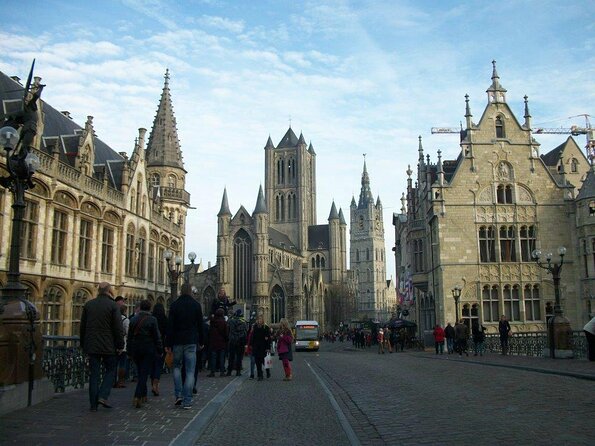
- Start at Sint-Baafsplein: The route begins and ends in Ghent’s central square, close to Saint Bavo’s Cathedral and the Belfry.
- Expect two to four hours: You control the pace, so the walk can be a brisk outing or a longer sightseeing session with stops.
- One price covers six people: At $37.24 per group, the cost works out well for a full family or group of friends.
- Use the free smartphone app: The game depends on your phone and data, which are not supplied.
- See major sights without a guide: The route includes Gravensteen, Ghent Town Hall, the Leie riverfront, Patershol, and the city’s famous towers.
- Plan extra time for interiors: The activity takes you past major sights, but attraction admission is not listed as included.
Why a scavenger hunt works well in Ghent
Ghent’s main sights are packed into a walkable historic center. The medieval core circles the Korenmarkt and follows the Leie, with narrow lanes and grand public buildings appearing one after another. A normal sightseeing walk can feel like a string of pretty views. Clues give you a reason to look more closely.
The format is simple. You connect to the app, form a team of up to six, and work through a city trail. The exact clue system is not described in detail, so I would expect prompts that ask you to observe places around you rather than a full spoken tour.
That difference matters. A guide can explain dates, politics, and architectural details in a smooth story. An app asks you to make your own discoveries. If your group likes solving clues and keeping children involved, that trade-off is useful. If you want deep explanations at every stop, you may need a separate guidebook or museum visit.
The route is private to your group. You are not tied to a fixed departure with strangers, and the listed operating hours run from Monday through Sunday, 12:00 AM to 11:59 PM. In practical terms, the experience is offered throughout the day. Still, daylight will make the outdoor clues and old streets easier to enjoy.
More Self-Guided Trails in Ghent
- Discover Ostend while playing! Escape game – The Walter case
★ 4.0 · 16 reviews - e-Scavenger hunt Kortrijk: Explore the city at your own pace
★ 4.5 · 15 reviews - Ghent Walking Tour with Audioguide on Your Smartphone
★ 4.5 · 13 reviews
Starting at Sint-Baafsplein
The meeting point is Sint-Baafsplein, one of the best places to begin a first look at central Ghent. Saint Bavo’s Cathedral and the Belfry are nearby, so you are dropped into the heart of the city from the first minute.
This starting point also helps with orientation. Ghent has a lot of similar-looking lanes, and the route’s app should keep you moving from one sight to the next. Since the activity returns to the meeting point, you do not need to arrange a pickup or figure out where the walk ends.
Give yourself a few minutes before starting. Check that your phone is charged, confirm your data connection, and make sure everyone in your group understands how the app works. The provider supplies the app, but not the phone or data. That is the main practical requirement.
Vrijdagmarkt and the city’s public life
The route includes Vrijdagmarkt, one of Ghent’s oldest squares. The square covers about one hectare, giving it a broad, open feel that contrasts with the tight lanes nearby.
This is a useful stop for understanding how Ghent’s public spaces fit together. A large square gives the clue game room to spread out, but it also means you may need to look carefully for the exact point the app wants you to notice. The square is a place to pause, take stock, and let your group solve the next task together.
Because this is a self-guided walk, you can take your time here. If your group is moving quickly, you may pass through in minutes. With children, the clue may turn the square into a short game rather than just another photo stop.
Ghent Town Hall and medieval power

Ghent Town Hall is a four-sided complex bordered by the Botermarkt, Hoogpoort, Stadhuissteeg, and Poeljemarkt. It is less a single isolated building than a block of civic architecture, which makes it a good place for an observation-based clue.
The town hall helps show how much of Ghent’s story was shaped by city government and trade. The route does not promise a guided interior visit, so treat this as an exterior sightseeing stop unless you arrange separate admission or access.
I like this kind of stop in an app route because the building rewards close looking. You can compare its different sides, follow the surrounding streets, and then continue without being held to a group schedule.
Same city, a completely different way to spend a day:
- Ghent: 50-Minute Medieval Center Guided Boat Trip
★ 4.5 · 5,637 reviews - Historical Walking Tour: Legends of Gent
★ 5.0 · 1,761 reviews - Ghent: 40 Minute Medieval Center Guided Boat Tour
★ 4.4 · 884 reviews - Evening Tour of the Dark Side of Gent
★ 5.0 · 646 reviews
Saint Bavo’s Cathedral and the Ghent tower row

Saint Bavo’s Cathedral is the oldest parish church in the lively center. It was built on the site of a 10th-century church and an earlier Romanesque church, giving this one location several layers of religious history.
The cathedral is close to the starting point, so it may also be the first major landmark you see. The clue format can help you notice the building’s place in the square, rather than treating it as a quick backdrop.
Nearby, the Belfry rises 95 meters above the city. It is the middle tower in Ghent’s well-known row of towers, with the cathedral and Saint Nicholas’ Church completing the sequence. This is one of the route’s essential views.
The Belfry is a strong photo stop, but remember that the activity price covers the city trail and app, not listed attraction tickets. If you want to go inside any sight, check admission separately. The route itself remains useful even if you only view the tower from the square.
The Devil’s Stone and a taste of old Ghent

Another stop is a stone building named for its builder, the knight Gheeraert Vilain, who was nicknamed the Devil. The building was sold to the city of Ghent around 1328.
That detail gives the scavenger hunt a nice change of pace. Instead of focusing only on famous monuments, the route points you toward a less familiar piece of the city’s built past. The name alone is memorable, and the clue gives your group something specific to search for.
This is where the app format can be more engaging than a simple list of sights. You are not only walking toward the next headline attraction. You are also watching for smaller details that might otherwise be missed.
Gravensteen, Ghent’s medieval castle

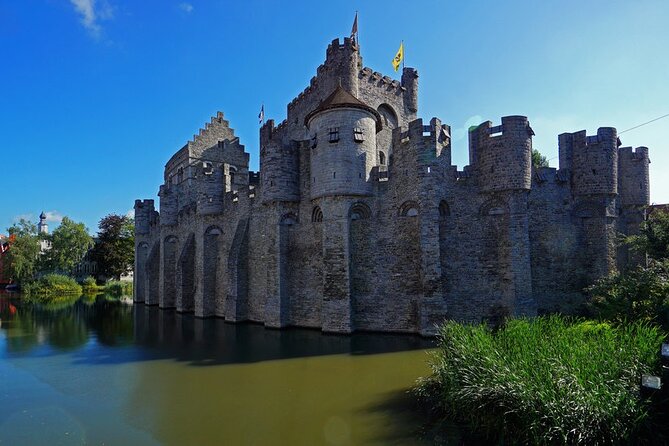
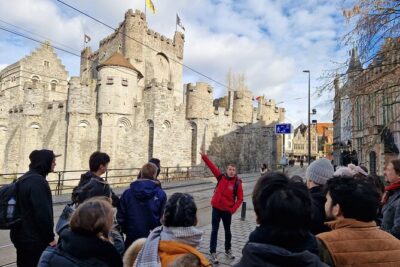
Gravensteen is the only remaining medieval castle in Flanders with an almost intact defense system. It is the route’s most dramatic sight, with stone walls and a clear sense of medieval military design.
You can view the castle as part of the trail, but admission is not listed among the inclusions. If you want to enter, budget extra time and check the separate ticket arrangements. The two to four hour estimate refers to the self-guided route, so an interior visit could affect your timing.
Even from outside, Gravensteen gives the walk a strong focal point. After squares, churches, and civic buildings, the castle changes the mood. It also makes a good point for a group photo or a break before continuing through the center.
Graslei, Korenlei, and Saint Michael’s Bridge
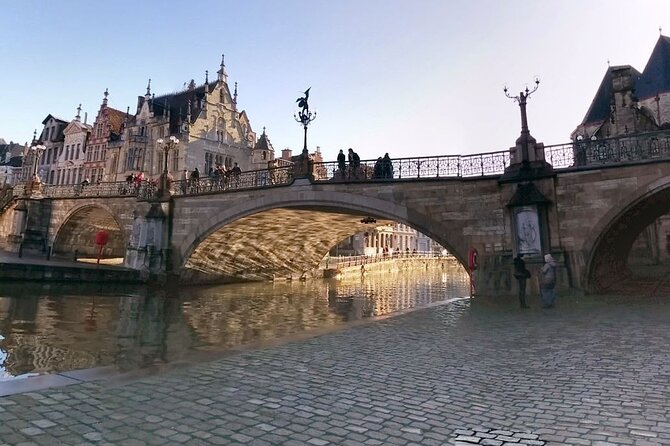
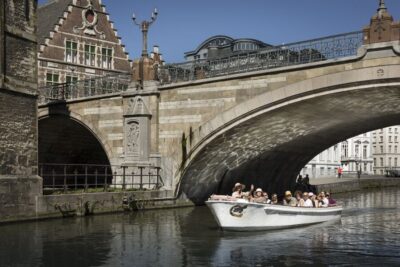
The Graslei and Korenlei are among Ghent’s most attractive outdoor stops. Historic buildings line both sides of the Leie, with terraces, water, and boats adding movement to the scene.
This is a place where you should resist rushing. The route may give you a clue to solve, but the riverfront deserves a few extra minutes. Sit at a terrace if your group wants a break, or simply watch the boats and look across the water at the old façades.
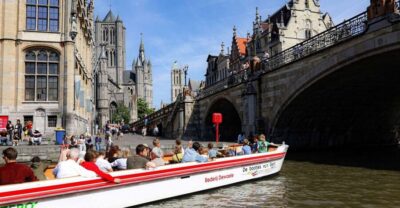
Saint Michael’s Bridge is close to Korenmarkt and Saint Michael’s Church. It crosses the Leie and faces toward the city center, giving you one of the clearest views of Ghent’s historic core.
The bridge may be crowded at popular times, so a clue can be harder to complete quickly if you need to inspect a particular feature. The upside is that the stop connects several major sights in one view. It is a useful place to understand the shape of central Ghent before the route turns into narrower streets.
Saint Nicholas’ Church and the merchants’ quarter
The route also includes a church that has existed since the 11th century. It served the wealthy merchants and guilds of Ghent, linking the religious building to the city’s commercial life.
This church is part of the same central group of landmarks near the Korenmarkt and Belfry. Its presence helps explain why the tower row matters. These are not isolated monuments scattered around town. They sit within the old center, close to the streets where trade and civic activity once shaped daily life.
A self-guided clue may give you just enough information to notice the church’s role. If you want a fuller account of its interior or artwork, plan extra research or a separate visit.
Korenmarkt and the grain trade
Korenmarkt has been tied to grain trading since the 10th or 11th century. Grain arrived in Ghent through the Leie or Scheldt and was traded in this square.
That fact gives the route a practical historical thread. Ghent’s old center was not preserved as a stage set. Its squares grew from trade, transport, religion, and city government. The riverfront and market spaces make more sense once you connect them to the goods moving through town.
The square can also be a busy point on the walk, with plenty of pedestrian traffic and nearby terraces. Keep your phone secure while using the app and make sure your group stays together when crossing streets or moving between clues.
Patershol and the narrow medieval streets
Patershol is an old neighborhood in the historic center. Its narrow medieval streets now contain many cafés and restaurants, making it a natural place to pause after part of the game.
This section adds atmosphere without requiring a major attraction ticket. You can focus on the shape of the lanes, browse menus, or use the neighborhood as a meal stop. Since the activity is self-paced, your group can take a longer break here without holding up anyone else.
The drawback is easy to predict: narrow streets can make it harder to gather a large group around one phone. If six people join, let one or two handle the app while the rest listen. That keeps the walk moving and avoids a small crowd blocking the lane.
Graffiti Street and Ghent’s modern edge
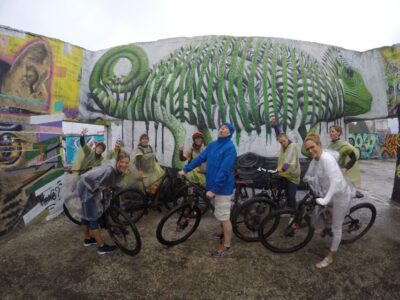
The winding alley between Hoogpoort and Donkerstraat is also called Graffiti Street because of its appearance. It offers a sharp contrast to the formal churches, towers, and medieval stone buildings elsewhere on the route.
This is a good reminder that Ghent is not only about old architecture. The city trail places historic landmarks beside a changing, informal art space. The alley is narrow, so take your time and look along the walls rather than expecting one grand view.
The exact artwork can change, which is part of the appeal of a street like this. The app gives you a reason to pass through, but the visual details are worth your own attention too.
The Museum of Fine Arts as an optional addition
The Ghent Museum of Fine Arts is one of Belgium’s oldest museums. Its collection includes paintings, sculptures, drawings, etchings, and tapestries.
The museum is included as a stop on the route, but the activity does not list museum admission. Think of it as a useful waypoint rather than a guaranteed museum visit. If art is a priority, plan a separate entry and allow more than the basic two-hour route.
This is also where the flexible format helps. You can finish the outdoor trail first, then decide if you have the energy and time for the museum. A fixed tour would make that choice for you. Here, the decision remains in your hands.
Price, pace, and group value
The listed price is $37.24 per group of up to six people. For one person, that is not especially cheap. For six, it comes to roughly $6.21 each, before any separate attraction admissions.
That makes the experience best suited to families and small groups who will actually use the full team allowance. Two people can still enjoy it, but a private walking tour with a human guide may offer more explanation for a similar total cost, depending on local prices.
The two to four hour duration is a useful range rather than a strict timetable. A fast group may complete the clues closer to two hours. A family that stops at the riverfront, eats in Patershol, or enters a sight will need longer.
The included value is the structure: a route, a game, and a way to explore independently. The price does not cover your phone, data, food, or listed attraction admissions. Those costs are easy to manage, but you should know about them before starting.
Who will enjoy this most
I would choose this for a family with older children, a group of friends, or anyone who likes mixing sightseeing with simple challenges. The private format lets you set the pace, and the family-friendly game gives younger participants a role beyond following an adult from one monument to the next.
It also suits independent visitors who do not want a fixed guide schedule. You can begin any time during the stated operating period and return to the same central meeting point.
I would be more cautious if your main goal is detailed historical interpretation. The route supplies an interactive framework, not a named guide or a lecture at every stop. The experience is also less appealing if no one in your group has a suitable phone or mobile data.
The activity is listed as suitable for most participants, allows service animals, operates near public transportation, and is user-friendly for people with hearing impairments. These are helpful features, though the route still involves walking through historic streets and public squares.
Booking and cancellation details
Confirmation is received at booking. Free cancellation is available until 24 hours before the experience start time. If you cancel or request changes within the final 24 hours, the amount paid is not refunded and changes are not accepted.
The experience is offered by Qula. It is available in English, and the start and end point is Sint-Baafsplein in Ghent.
Should you book the Ghent e-scavenger hunt?
Book it if you want a flexible outdoor introduction to Ghent and your group enjoys solving clues together. The route reaches the city’s biggest sights while also adding smaller stops such as the Devil’s Stone and Graffiti Street. For six people, the group price is appealing.
Skip it if you want a guide to explain every church, castle, and square in depth. In that case, choose a traditional walking tour and use the saved time for the cathedral, Belfry, Gravensteen, or Museum of Fine Arts. The best reason to choose this activity is not expert narration. It is the freedom to explore Ghent at your own speed, with just enough game structure to keep the walk lively.
FAQ
Where does the e-scavenger hunt start?
It starts at Sint-Baafsplein, 9000 Gent, Belgium.
Where does the activity end?
The route ends back at the meeting point at Sint-Baafsplein.
How long does the experience take?
The estimated duration is two to four hours.
How much does the activity cost?
The listed price is $37.24 per group, with up to six people included.
Is this a private activity?
Yes. Only your group participates.
Is a smartphone included?
No. You must provide your own smartphone.
Is mobile data included?
No. Smartphone and data are not included.
What language is offered?
The experience is offered in English.
Can I cancel for a full refund?
Yes, if you cancel at least 24 hours before the experience start time. Cancellations made less than 24 hours in advance are not refunded.
Is the activity available every day?
Yes. It is listed as available Monday through Sunday, from 12:00 AM to 11:59 PM.
Just added around Ghent
- Ghent Running and Sightseeing Tour★ 5.0 · 3 reviews
- Ghent Walking Tour – City Highlights and Beyond Tradition★ 4.5 · 3 reviews
- Ghent: Walking Tour from Friday Market to the Cathedral★ 4.8 · 3 reviews
- Ghent: City Walk with Audio Guide in 7 Languages on your Phone★ 4.5 · 3 reviews
- Children’s escape game in the city of Ghent Marsupilami★ 5.0 · 3 reviews
- Discover Ghent while playing! Escape game – The Walter case★ 4.5 · 4 reviews
- Discover Ghent while playing! Escape game – The alchemist★ 4.0 · 4 reviews
- e-Scavenger hunt Mons: Explore the city at your own pace★ 5.0 · 4 reviews
Ghent Tours, compared.

Browse the lists this tour appears in