
Reviewed · GHENT TOURS
Historical Walking Tour: Legends of Gent
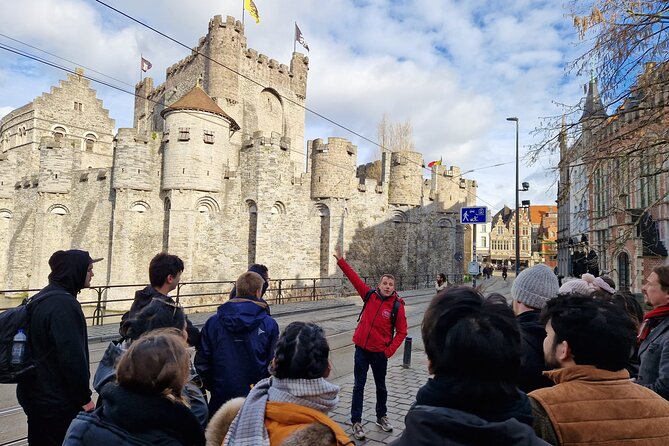
Ghent’s best stories are hiding in plain sight, and this walk brings them together in one tidy route. You’ll trace the city’s medieval trade, stubborn independence, grim punishments, rebellious citizens, and famous art while moving from St Michael’s Bridge to the Belfry. The most memorable detail may be how ordinary buildings reveal old power struggles.
I like the pay-what-you-want format, which keeps the upfront cost remarkably low at $3.62 and lets you judge the experience for yourself. I also like the route: it covers the major sights without spending two hours inside one monument, so you get your bearings quickly and can return later to the places that deserve a closer look.
The main consideration is pace. You remain on your feet for about two hours, mostly on old city streets and cobblestones, and each stop gets only a short explanation. Also, confirm the payment arrangement at the start. The stated setup is a small booking charge followed by a tip based on your experience, but one serious complaint describes confusion over being asked to pay again.
Five things to know before you go
- Ghent’s medieval port comes first: St Michael’s Bridge, Graslei, and Korenlei explain how trade shaped the city.
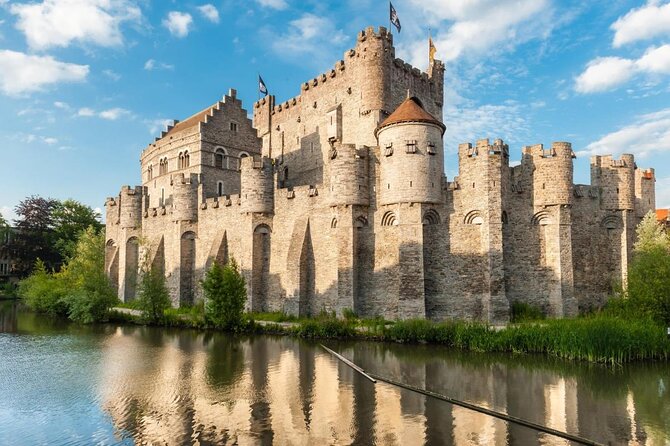
- The castle is part of the city center: Gravensteen is not a distant fortress. It rises directly among Ghent’s streets and canals.
- The route ends at the Belfry and St Nicholas’ Church: You finish near the city’s central squares, well placed for more sightseeing.
- Storytelling is the heart of the walk: Guides including Tatiana, Kasia, Kenny, Sophia, Robin, and Florian are praised for humor, clear English, and lively local tales.
- You pay mainly for orientation and context: Monument entry is not generally part of the walk, so plan separate visits if you want to go inside Gravensteen, the Design Museum, the Town Hall, or the Belfry.
Why this Ghent walk works as a first look
This is not a museum tour with long indoor talks. It is a city orientation walk built around thirteen outdoor stops, short explanations, and stories that connect one building to the next.
That format suits Ghent. The center is compact, but its past is not simple. Merchants, guilds, rulers, religious groups, workers, and rebels all left their mark. A guide can point out why a handsome façade matters, why a square earned a grim nickname, or why the Town Hall looks as if several buildings were joined without a plan.
The tour is offered in English and is capped at 35 people. That is large enough to give the guide energy, but it can make positioning important at busy sites. A group of 18 to 20 has been described as comfortable, and one guide used a microphone so everyone could hear. Still, you should arrive ready to stand where you can see the guide, especially around crowded canals and squares.
Guides vary by departure. Names praised for their delivery include Tatiana, Kasia, Kenny, Sophia, Robin, Florian, Liedewei, Camilla, Hans, and Ksenia. Do not book expecting one particular person unless the operator confirms it. The consistent strength is the style: local stories, architecture, humor, and practical suggestions for restaurants, beer, chocolate, and things to do after the walk.
More History Tours in Ghent
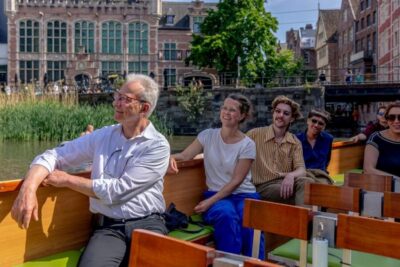
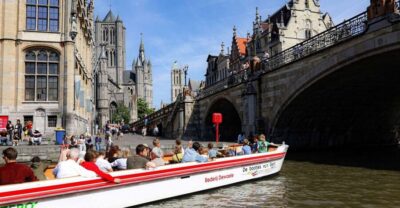
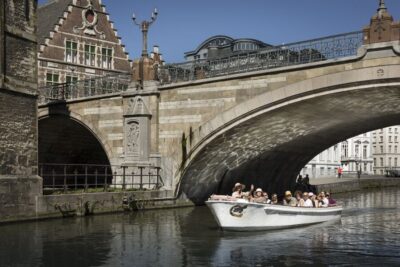
- Ghent: 40-Minute Historical Boat Tour of City Center
★ 4.3 · 430 reviews - Private Historical Tour: The Best of Ghent
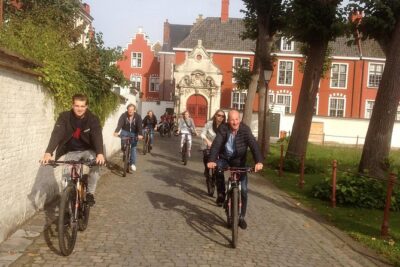
★ 5.0 · 115 reviews - Bicycle tour in historic Ghent
★ 5.0 · 87 reviews
St Michael’s Bridge gives you the classic Ghent view
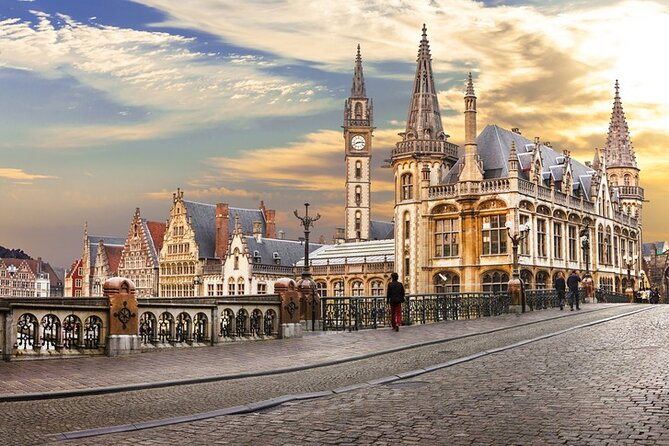
The tour begins at Hostel Uppelink on Sint-Michielsplein, close to St Michael’s Bridge. This is an excellent starting point because the bridge gives you a broad view toward Ghent’s famous three towers.
From here, the guide introduces Ghent as a medieval trading power and explains why waterways mattered so much. The view helps you connect the city’s skyline to its past instead of treating the towers as three unrelated photo stops.
Allow about 15 minutes here. You will hear the basic story of the city and get the visual map needed for the rest of the walk. I especially value this opening because it gives you a sense of direction before you begin threading through the older streets.
The bridge is also one of the best places for photographs. If you want a quiet picture, you may need to return later, since the tour has to keep moving and the bridge can be busy.
Graslei and Korenlei reveal the old port
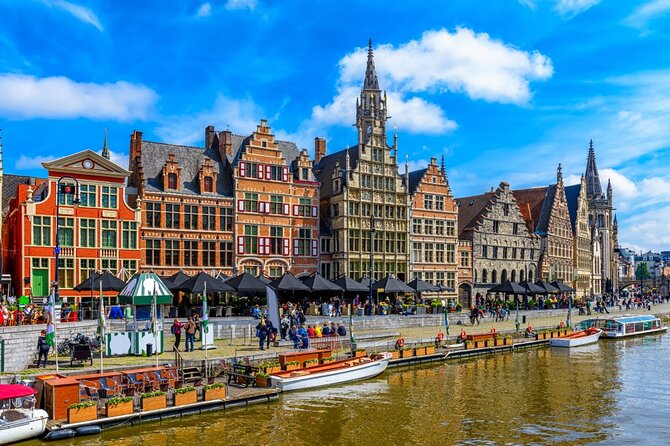
The route continues along Graslei and Korenlei, the canalside center of historic Ghent. These quays once handled the city’s trading activity, and the buildings around them preserve that commercial character.
Your guide points out which structures were tied to trade and how the waterfront functioned as a port. This is more useful than simply hearing a list of building names. You learn to read the canal as working infrastructure, not just a scenic backdrop.
The stop lasts around 10 minutes, but you will also spend time walking along the water. This is a spot where the guide’s storytelling matters. The architecture is attractive enough to distract you, yet the real point is understanding why this stretch became the economic heart of the city.
The route does not include a boat ride or extended free time here. If you want canal photos without a group around you, mark Graslei and Korenlei for a return visit.
Design Museum Gent brings out Ghent’s stubborn side
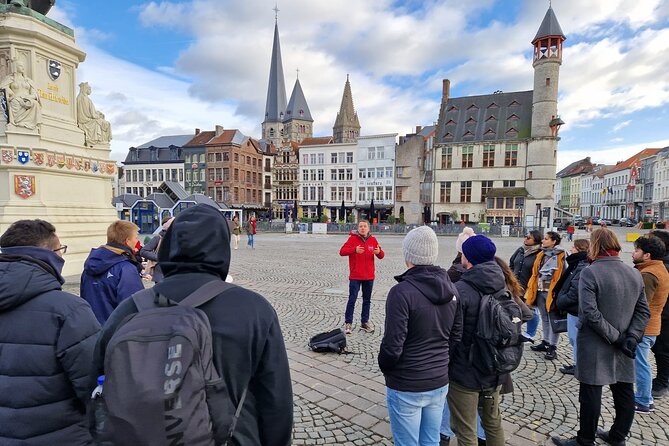
At the Design Museum Gent, the guide explains how one feature of the museum reflects the stubborn and rebellious character associated with the people of Ghent.
The appeal of this stop is not an extended museum visit. Admission is not included, and the tour uses the building as a way into local character and civic identity. You get a quick explanation outside, then continue.
That distinction matters if you are booking this walk to see museum collections. You will need a separate ticket and separate time for the museum itself. If your goal is to understand how Ghent sees itself, though, this brief stop adds a useful layer beyond kings, churches, and medieval merchants.
More Walking Tours in Ghent
- Ghent: Belgian Chocolate Walking Tour with Tastings
★ 4.9 · 259 reviews - Gastronomic Walking Tour of Gent – Tasters included
★ 5.0 · 199 reviews - Ghent: Private 2-Hour Walking Tour
★ 4.7 · 134 reviews - Ghent: Famous Belgian Chocolate Walking Tour with Tastings
★ 5.0 · 131 reviews
Het Groot Vleeshuis adds a darker note
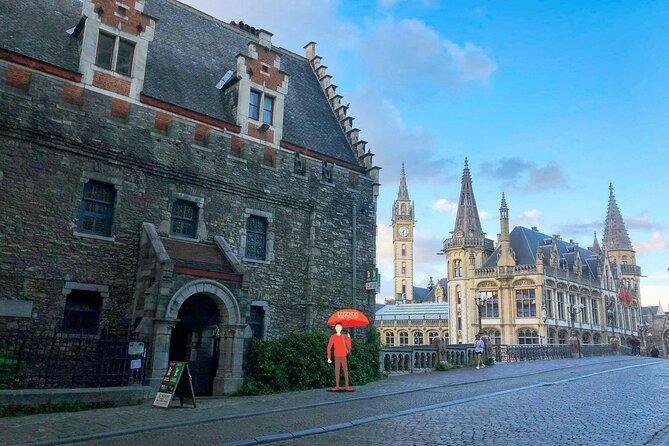
Across the water, you’ll see Het Groot Vleeshuis, the medieval covered Great Butchers’ Hall. The building is impressive, but the guide does not leave the story at architecture.
This stop brings out some of the darker facts tied to the hall. The exact storytelling will vary by guide, but the purpose is clear: Ghent’s attractive old center was also a place of strict trades, public authority, and difficult daily life.
You spend about 10 minutes here, with no entry fee included or required for the explanation. It is a good reminder that old buildings often served practical and sometimes unpleasant purposes.
Gravensteen is a castle in the middle of the city
Gravensteen, the Castle of the Counts, is one of the route’s headline sights. Unlike a castle set beyond the city, this medieval fortress sits directly in the center, surrounded by streets, canals, shops, and daily city life.
The guide covers its impressive past from outside. That gives you the essential context before deciding if you want to pay for a proper interior visit. Admission to the castle is not included, so do not mistake the stop for a castle tour.
Ten minutes is enough to understand why the building matters, spot its defensive character, and hear the main stories. It is not enough for a detailed examination of rooms, displays, or views from the walls. I would use this stop as a preview, then return at another time if Gravensteen is high on your list.
St. Veerleplein connects death and daily life
The square in front of Gravensteen is St. Veerleplein. The guide presents it as both the square of death and the square of life, then explains the contrast.
This is the kind of stop that makes a walking tour worthwhile. A square can look ordinary until you learn how it was used and what happened there. The short talk helps you see the space as a stage for public events, power, punishment, and everyday activity.
You will spend about 10 minutes here. Because the stop is outdoors and near the castle, it also gives you a chance to look back at Gravensteen from a different angle.
Huis van Alijn tells a sad hospital story
The House of Alijn, or Huis van Alijn, is the only remaining god house in Ghent. The guide explains how it became a hospital and shares the unfortunate story behind that change.
The unusual name and the building’s former purpose give this stop a different mood from the grand churches and civic monuments. It focuses on care, illness, and the less polished side of city life.
The explanation takes about 10 minutes and does not require an entry ticket for the outdoor stop. If you later visit the museum inside, allow separate time and admission. The walk itself gives you the historical reason to put it on your list.
Vrijdagmarkt puts civic conflict on a public stage
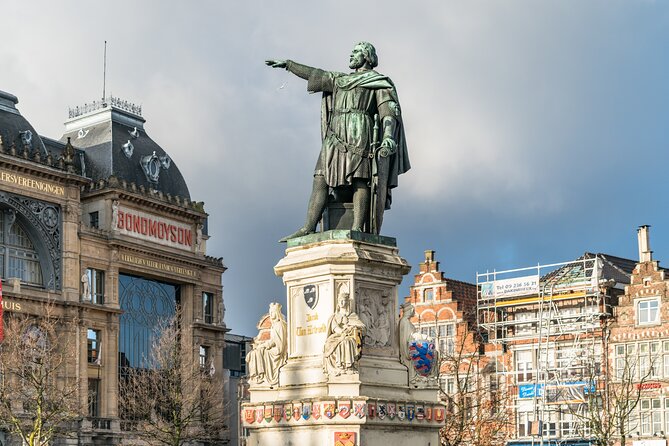
Vrijdagmarkt has played a major role in Ghent’s story. The guide explains the square’s role and discusses the person represented by the statue in its center.
This is another place where a quick orientation can save you from walking past an important monument without understanding it. Ghent’s public squares were not just places for markets. They also reflected political authority, civic pride, and conflict.
The stop lasts around 10 minutes. Look carefully at the surrounding buildings and the statue while the guide speaks. The tour’s value here is the connection between the physical square and the decisions made in it.
Werregarenstraat shows the city’s rebellious streak
Werregarenstraat is Ghent’s designated graffiti alley. The city created this space so street artists could work without covering the monumental buildings elsewhere.
The alley gives the tour a sharp change of tone. You move from medieval masonry and formal civic architecture to an evolving display of street art. It also returns to a theme that appears throughout the walk: Ghent has a strong independent streak and does not always fit neatly into official rules.
There is no admission fee, and the visit is brief. The artwork changes, so what you see depends on the day. Treat it as a living part of the city rather than a fixed attraction.
Ghent Town Hall explains a confused façade
Ghent Town Hall, or Stadhuis, looks as if different architectural ideas were attached to one building. The guide uses its appearance to explain the most important conflict in the city’s past.
This is a smart use of architecture. Instead of memorizing dates, you get a visible clue that something went wrong, changed, or remained contested. The building becomes a record of civic tension.
The stop lasts about 10 minutes. Entry is not included, so you are mainly seeing the exterior and hearing the story. That is enough for most first-time visitors, but anyone interested in interiors or city administration will need a separate visit.
St Bavo’s Cathedral holds Ghent’s great artwork
St Bavo’s Cathedral is one of the major stops. Its history reaches across centuries, and it contains important works of art, most famously the Ghent Altarpiece by the Van Eyck brothers.
The guide gives you the essential background and explains why the cathedral matters. The outdoor portion cannot replace time inside. If you want to see the altarpiece properly, plan a separate visit and check the current admission arrangements yourself, since the walking tour does not include interior entry.
Even a short explanation helps. Without context, the cathedral can feel like another grand Gothic building. With the story of its art and place in Ghent, it becomes one of the stops you may want to revisit.
The Belfry tells a strange local legend
The Belfry of Ghent is known as the people’s tower. The guide links it to the city’s independence, power, and stubborn civic character, then points out that it once served as a prison.
Its façade also carries a bizarre legend, which provides the lighter ending to a serious story about public authority. This mix of politics, architecture, and folklore is typical of the tour’s approach.
The route ends at the Belfry on Sint-Baafsplein. Admission is not included, so you can choose later if you want to go inside. Ending here is practical: you are near St Bavo’s Cathedral, the Town Hall, and central squares, with the rest of Ghent easy to explore on foot.
St Nicholas’ Church closes the loop
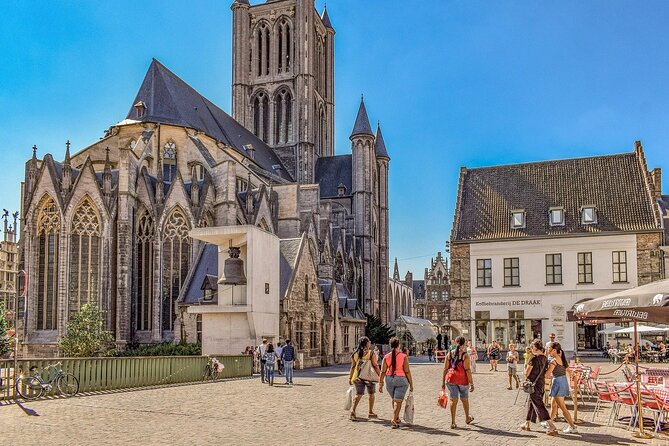
The final stop is St Nicholas’ Church, an early 12th-century building overlooking Korenmarkt. St Nicholas is the patron saint of merchants and sailors, making the church a fitting final chapter after the earlier discussion of Ghent’s trading life.
The façade also shows the legend of its patron saint. That gives the walk a clean ending, returning you to merchants, waterways, religion, and storytelling in one place.
The church is free to view from outside, while the tour itself does not include an interior visit. If you have extra time, compare this façade with the other towers you saw from St Michael’s Bridge. The route begins with the skyline and ends among the buildings that create it.
The $3.62 price needs a little explanation
At $3.62 per person, the initial price is unusually low for a two-hour guided walk. The reason is the pay-what-you-want model. The booking price is not meant to be the guide’s full compensation, so you are expected to decide what the experience was worth at the end.
That can be excellent value if you want a lively introduction without paying for a fixed-price premium tour. You get an English-speaking local guide, the route, historical context, and practical suggestions for food, beer, chocolate, and later sightseeing.
The value drops if you expect admission to the major monuments. Gravensteen, the Design Museum, the Town Hall, and the Belfry are not included as interior visits. Think of the walk as a guided preview and orientation, not a package covering every ticket.
There is one important caution. One complaint describes a family being asked to pay more than €200 again despite having booking proof, with different amounts apparently requested from different people. This is sharply at odds with the overwhelmingly positive experience record, but it is serious enough to justify checking the payment terms clearly before the tour begins. Keep your confirmation and receipt available, and ask the guide to explain what is included.
Who should book this walk
I would choose this tour for a first day in Ghent, especially if you want the city to make sense before exploring on your own. The route covers the essential center, and the local stories help you decide where to spend your remaining time.
It suits people who enjoy history delivered with humor rather than a long academic lecture. Several guides are praised for warm delivery, clear English, strong storytelling, and useful food recommendations. One guide also handled hot weather thoughtfully, which matters during a two-hour walk.
Families and older visitors should consider the length and surface. Most people can participate, but you are on your feet for roughly two hours, and cobblestones may be uncomfortable for some. Service animals are allowed, and the starting point is near public transportation.
It is less suitable if you want a small private tour, extensive time inside monuments, or a slow photography walk. A group can reach 35 people, and the schedule moves steadily from stop to stop.
Booking, weather, and timing tips
The tour starts at Hostel Uppelink, Sint-Michielsplein 21, and ends at the Belfry on Sint-Baafsplein. The end point is useful because it places you beside several of Ghent’s main sights rather than sending you back to the starting point.
Confirmation is provided when you book. The experience requires good weather and a minimum number of participants. If poor weather or low numbers cancel it, you are offered another date or experience, or a full refund.
You can cancel for a full refund up to 24 hours before the start time. Changes or cancellations within 24 hours are not accepted and are not refunded. The tour is booked an average of 16 days ahead, so I would not leave it until the last moment if your Ghent visit is short.
Should you book Legends of Gent?
Yes, if you want a low-cost, story-led introduction to central Ghent. The strongest parts are the route, the local legends, the skyline views, and the way the guide connects grand monuments with trade, conflict, punishment, religion, and street art.
I would book it early in your stay, then return to Gravensteen, St Bavo’s Cathedral, or the Belfry if one catches your interest. Go in expecting an outdoor overview, not a series of interior tours, and clarify the pay-what-you-want arrangement at the beginning.
With a 4.9 rating from 1,761 reviews and 98 percent recommendation, the experience has a strong record. The one payment complaint deserves attention, but it does not change the central advice: for a few dollars upfront, this is a smart way to get your bearings and hear the stories that make Ghent more than a pretty canal city.
FAQ
Where does the Historical Walking Tour: Legends of Gent start?
The tour starts at Hostel Uppelink, Sint-Michielsplein 21, 9000 Gent, Belgium.
Where does the tour end?
The tour ends at the Belfry of Ghent, or Belfort van Gent, on Sint-Baafsplein.
How long does the tour last?
The tour lasts approximately two hours.
Is the tour offered in English?
Yes. The experience is offered in English and uses a mobile ticket.
Are monument entrance fees included?
The walking tour includes all listed fees and taxes, but interior admission is not included for places such as Gravensteen, the Design Museum Gent, Ghent Town Hall, and the Belfry.
What is the cancellation policy?
You can cancel at least 24 hours before the start time for a full refund. Cancellations and changes made less than 24 hours before the start time are not accepted or refunded. If bad weather or too few participants cancel the experience, you are offered another date or experience, or a full refund.
Just added around Ghent
- Ghent Running and Sightseeing Tour★ 5.0 · 3 reviews
- Ghent Walking Tour – City Highlights and Beyond Tradition★ 4.5 · 3 reviews
- Ghent: Walking Tour from Friday Market to the Cathedral★ 4.8 · 3 reviews
- Ghent: City Walk with Audio Guide in 7 Languages on your Phone★ 4.5 · 3 reviews
- Children’s escape game in the city of Ghent Marsupilami★ 5.0 · 3 reviews
- Discover Ghent while playing! Escape game – The Walter case★ 4.5 · 4 reviews
- Discover Ghent while playing! Escape game – The alchemist★ 4.0 · 4 reviews
- e-Scavenger hunt Mons: Explore the city at your own pace★ 5.0 · 4 reviews
Ghent Tours, compared.




Browse the lists this tour appears in