
Reviewed · GHENT TOURS
Evening Tour of the Dark Side of Gent
Ghent’s dark past is not hard to find once the sun goes down. On this 1-hour-45-minute walk, you hear about torture, executions, religious conflict, royal power, and the legends attached to some of the city’s prettiest buildings. The mood is more lively than frightening, with guides such as Kenny, Isabel, Ben, and Julian using jokes and theatrical storytelling to keep the medieval gloom moving.
I like the way the route mixes famous sights, including St Michael’s Bridge and the Castle of the Counts, with less obvious corners such as Rabot Sluice and Patershol. I also like the price: at $3.62 per person, it offers a lot of guided sightseeing for very little money. The main drawback is that the dark theme can be uneven, and the tour may be canceled if too few people book or if the weather turns bad.
Key points to know before you go
- A night walk with a grim medieval twist: Expect stories of murder, punishment, torture, religious wars, and political trouble.
- The route covers much of central Ghent: You walk from St Michael’s Bridge through the medieval harbor, past the Castle of the Counts, and finish in Patershol.
- Guides make a big difference: Kenny receives especially strong praise for his humor, energy, and storytelling, while Isabel, Ben, and Julian are also named as engaging guides.
- You get both famous views and quieter stops: The route includes Ghent’s three towers, the old harbor, Rabot Sluice, and small monuments you could easily miss alone.
- Wear comfortable shoes: The walk is mostly level and taken at a gentle pace, but it covers a substantial part of the city.
- The dark material is not for everyone: Some stories involve blood, executions, torture, and tragedy, though the tone is often suitable for families.
Why Ghent’s darker past works so well at night
Ghent is easy to admire in daylight. Its canals, stone buildings, and towers make a handsome first impression. This walk gives you a different way into the city, using the less flattering side of medieval life to explain how Ghent grew, suffered, and changed.
The tour is not a ghost walk in the narrow sense. You are not promised supernatural sightings or staged scares. Instead, the guide uses real places as a backdrop for stories about power and punishment, with myths mixed in where the old tales become too strange to ignore.
That blend is the tour’s main strength. You might hear a grim story about an execution, then turn a corner and learn how a nearby bridge, palace, or fortification fits into Ghent’s wider past. The jokes matter, too. Medieval cruelty is heavy material, and an animated guide can make it easier to listen without turning the walk into a lecture.
The exact balance depends on the guide. Kenny is repeatedly singled out for his comic timing, animated delivery, and ability to involve the group. Isabel is described as enthusiastic and excited in her presentation, while Ben and Julian also receive praise for making the walk enjoyable. You should expect a lively storyteller rather than a formal academic talk.
A few more Ghent half-days to weigh up
- Evening Tour: The Dark Side of Bruges
★ 5.0 · 956 reviews - Evening Tour: The Dark Side of Brussels
★ 4.5 · 435 reviews - Evening Walking Tour: The Dark Side of Antwerp
★ 5.0 · 193 reviews
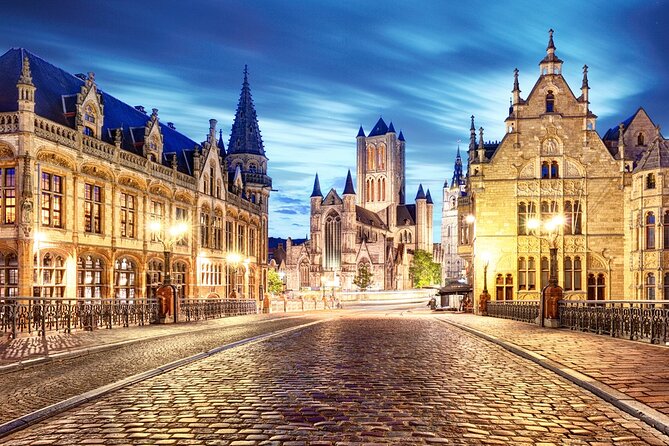
Starting at St Michael’s Bridge and the three towers
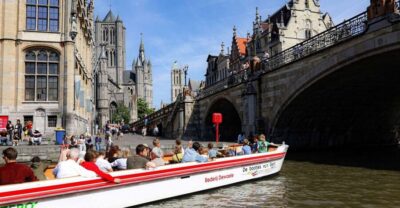
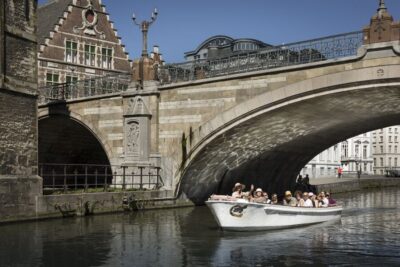
The walk begins outside Hostel Uppelink at Sint-Michielsplein 21. St Michael’s Bridge is a smart starting point because it gives you one of Ghent’s clearest city views before the route heads into its darker stories.
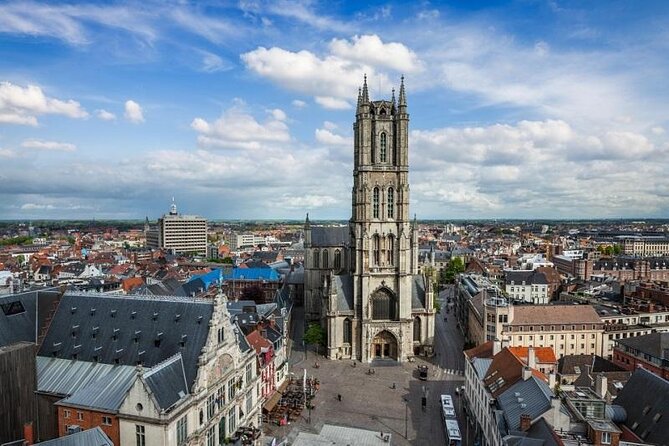
From here, the guide explains Ghent’s role as a medieval trading hub and points out the city’s three famous towers. This opening gives you useful bearings. You see how the major landmarks relate to one another, and the evening setting adds a different mood to the familiar skyline.
The first stop lasts about 15 minutes. Admission is free because the tour takes place outdoors, with no separate entry to a paid attraction included. You should arrive at the stated meeting point and check your confirmation carefully, since a few past bookings have involved confusion over the meeting address. That issue is not a reason to dismiss the walk, but it is a good reason to avoid arriving at the last moment.
One short stop concerns the cathedral, which is also called the Devil’s Tower. The tour uses the gruesome story behind that name to shift from broad city history into the darker material. The supplied schedule does not name the cathedral as a separate numbered stop, so treat it as a brief storytelling point rather than a long interior visit.
The medieval harbor at Graslei and Korenlei
The route then reaches Graslei and Korenlei, the old harbor district. These quays are among Ghent’s most attractive areas, but the tour gives them an economic edge instead of treating them as scenery alone.
You hear about the trading activity that helped make Ghent a major European economic center. This is one of the most useful parts of the walk because it explains why the city has such imposing buildings and why control of its waterways mattered so much.
The stop lasts about 10 minutes. It is short, but the harbor setting makes it a good place to connect wealth with social tension. Trade brought money and power, but medieval prosperity did not make life gentle for everyone. The tour’s darker stories make more sense after you understand what was at stake.
You also get a chance for nighttime photographs here. Several people particularly enjoy the scenic stops after dark, although low light can make small sculptures and architectural details harder to see. If photography matters to you, keep your phone ready, but do not expect every detail to be as clear as it would be in daylight.
Execution legends beside Appelbrugparkje
At Appelbrugparkje, the guide looks across the water toward the large Butchers’ Hall and tells the story of a father and son facing execution. A miraculous event supposedly saves them.
This is a good example of the tour’s mix of history and legend. The setting is real, while the story belongs partly to the world of old beliefs and oral tradition. The guide’s job is not simply to list dates, but to show how people once made sense of justice, fate, and miracles.
The stop is planned for about 10 minutes. You may find this story more memorable than a standard account of medieval law, especially if the guide performs it well. At the same time, you should keep your sense of proportion. Some tales are presented as legends, and one past participant felt that parts of the tour stretched credibility. That is a fair warning for anyone who wants strictly documented history.
Same city, a completely different way to spend a day:
- Ghent: 50-Minute Medieval Center Guided Boat Trip
★ 4.5 · 5,637 reviews - Historical Walking Tour: Legends of Gent
★ 5.0 · 1,761 reviews - Ghent: 40 Minute Medieval Center Guided Boat Tour
★ 4.4 · 884 reviews - Ghent Bike Tour Off-the-beaten-track
★ 5.0 · 505 reviews
The Castle of the Counts and the vanished Prince’s Court
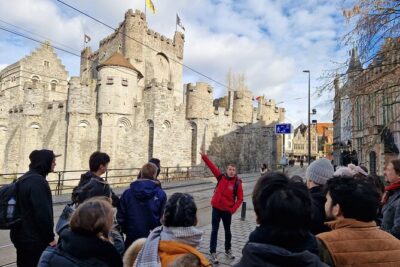
The Castle of the Counts is the route’s most obvious medieval fortress. The tour connects the castle to Count Baldwin, who built an early defense against Viking raids in the ninth century. Around this fortification, Ghent began to develop.
The castle gives the dark theme a strong physical setting. Its walls and towers make it easy to picture military power, threats from outside, and the authority of the count within the city. You do not enter the castle as part of this outdoor walk, but you hear enough about its role to make a later daytime visit more meaningful if you choose to pay for admission separately.
The stop lasts about 10 minutes. The short format keeps the route moving, though it also means the guide cannot cover every stage of the castle’s long story. You get an introduction, not a full castle tour.
Afterward, the route reaches what was once the Prince’s Court, a huge palace that is now difficult to picture from what remains. This is one of the more imaginative stops. The guide fills in the gaps and helps you understand how much royal and political activity once took place in this part of town.
You should expect fewer visible remains here than at the castle. That can be a drawback if you want a constant parade of impressive buildings, but it is also part of the appeal. The guide asks you to look beyond what survives and imagine the scale of a place that has largely disappeared.
Rabot Sluice and the last defensive tower
Rabot Sluice brings the walk to a quieter part of the route. Here, you see the only remaining tower from Ghent’s medieval defense wall, which once stretched for about 14 kilometers.
This stop gives the tour a practical side. Instead of focusing only on rulers and dramatic crimes, it shows the physical effort required to protect a growing city. Walls, gates, waterways, and towers shaped daily life as much as palaces did.
The planned visit lasts 10 minutes. It is one of the stops you might not seek out during a short first visit to Ghent, especially if you stay around the main central sights. That makes it useful for repeat visitors and for anyone who likes to see more than the standard postcard route.
The walk is generally slow and mostly level, according to the experience details and direct feedback. Still, you are on your feet for nearly two hours. Comfortable shoes are a must, and you should be ready for ordinary city walking rather than a quick loop around one square.
Charles V and the trouble of religious wars
The stop called Keizer Karel takes you to the Bridge of Imperial Delights. Four sculptures there show legendary scenes from the life of Charles V, and the guide explains some of them.
This is another place where small public art becomes more interesting once you know what to look for. Without a guide, you could easily cross the bridge and give the sculptures only a passing glance. With the stories attached, the bridge becomes a compact lesson in imperial image-making and local memory.
The stop lasts about 10 minutes. As with several points on the route, the value lies less in a long visit than in having someone direct your attention to details you might otherwise miss.
The following section covers the Religious Wars and the effect of Calvinist rule on Ghent. This subject adds political and religious conflict to the tour’s earlier stories of trade and punishment. It also shows that the city’s troubles did not end with the medieval period.
The treatment seems designed for a general audience rather than specialists. You should hear the basic forces and consequences, but not expect a full political history of Belgium. The reward is a clearer sense of how changes in religious rule affected the city and its people.
Finishing in Patershol, the Monk’s Hole
The tour ends in Patershol, a picturesque medieval quarter whose name means Monk’s Hole. This is a fitting final stop because the neighborhood provides a more intimate setting after the larger landmarks and fortified structures earlier in the walk.
Here, the guide turns to the Industrial Revolution and its social effects. The story is not only about factories and economic growth. It also concerns how industrial change altered neighborhoods, social classes, and Ghent’s fortunes.
The route finishes in the city center, near bars and restaurants. That makes the ending practical. You can continue the evening with a drink or meal instead of having to find your way back to the starting point.
Patershol also helps broaden the tour beyond murder and torture. If you expected nothing but gruesome tales, the final discussion of industrial change may feel less dramatic. I see it as a useful ending because it connects the old city to the process that helped revive its economy.
Price, group size, and the practical details
At $3.62 per person, this is unusually inexpensive for a guided city walk lasting about 1 hour and 45 minutes. All fees and taxes are included. At that price, I would view the tour as a low-risk way to get oriented in Ghent, not as a replacement for paid museum visits or a detailed private guide.
The maximum group size is 35 people. That is large enough to affect how easily you hear the guide, especially at busy outdoor sites. A strong performer such as Kenny can keep a group engaged, but you will want to stay near the guide and avoid drifting toward the back.
The experience is offered in English and uses a mobile ticket. Confirmation is provided at booking. The meeting point is Hostel Uppelink at Sint-Michielsplein 21, and the end point is Patershol.
Most people can take part, and service animals are allowed. The tour is near public transportation. The walk is described as slow and mostly level, but the comfortable-shoes advice remains important because the route covers many streets and districts.
Free cancellation is available up to 24 hours before the start time for a full refund. Changes or cancellations inside that window are not accepted for a refund. Poor weather can cancel the experience, and it also requires a minimum number of participants. If the minimum is not met, you are offered another date or experience, or a full refund.
Who will enjoy this Ghent walk most
I would choose this tour if you want a friendly introduction to Ghent with a darker edge. It suits first-time visitors who want to understand the city while seeing major landmarks, as well as repeat visitors looking for smaller monuments and less central streets.
Families can enjoy it, but parents should know that the stories include murder, torture, executions, blood, and tragedy. The lively tone softens the material, yet it does not remove it. Older children who like spooky history may have a good time, while very young children may find some sections unpleasant.
It is also a good pick for solo visitors and couples who want an organized evening without committing to a long formal tour. The route finishes near places to eat and drink, so it can fit neatly into a night in central Ghent.
You may want to skip it if you need a strictly factual account with no legends, jokes, or dramatic embellishment. One past participant also felt the walk was not dark enough, and that criticism points to a real issue: the experience is partly a general city history walk with a grim theme, not nonstop horror.
Should you book the Dark Side of Gent?
Book it if you like history delivered through stories, want to see Ghent at night, and appreciate a guide who can make old crimes and political struggles entertaining. The strongest reason to go is the combination of broad city coverage, unusual stops, and excellent value at the listed price.
Do not book it expecting a haunted-house experience or a fully documented account of every tale. The quality depends on the guide’s style, and the darker content varies in intensity. Arrive at the correct meeting point with comfortable shoes, keep an open mind about legend, and stay close enough to hear the storyteller.
For most visitors, this is an easy, inexpensive way to make Ghent feel more human. The city’s beauty remains, but you also see the fear, ambition, punishment, and social change behind it.
FAQ
Where does the Evening Tour of the Dark Side of Gent start?
The tour starts at Hostel Uppelink, Sint-Michielsplein 21, 9000 Gent, Belgium.
Where does the tour finish?
The tour ends in Patershol, 9000 Ghent, Belgium, in the city center near bars and restaurants.
How long does the tour last?
The experience lasts approximately 1 hour and 45 minutes.
What language is the tour offered in?
The tour is offered in English.
How much does the tour cost?
The listed price is $3.62 per person, with all fees and taxes included.
What places are included on the route?
The route includes St Michael’s Bridge, Graslei and Korenlei, Appelbrugparkje, the Castle of the Counts, the former Prince’s Court, Rabot Sluice, Keizer Karel, and Patershol.
Is the tour suitable for most people?
Most people can participate. The walk is described as mostly level and taken at a slow pace, but comfortable shoes are recommended.
Are service animals allowed?
Yes, service animals are allowed.
How large can the group be?
The tour can have a maximum of 35 participants.
Can I cancel for a full refund?
Yes. You can cancel at least 24 hours before the start time for a full refund. Cancellations or changes made less than 24 hours before the start time are not accepted for a refund.
Just added around Ghent
- Ghent Running and Sightseeing Tour★ 5.0 · 3 reviews
- Ghent Walking Tour – City Highlights and Beyond Tradition★ 4.5 · 3 reviews
- Ghent: Walking Tour from Friday Market to the Cathedral★ 4.8 · 3 reviews
- Ghent: City Walk with Audio Guide in 7 Languages on your Phone★ 4.5 · 3 reviews
- Children’s escape game in the city of Ghent Marsupilami★ 5.0 · 3 reviews
- Discover Ghent while playing! Escape game – The Walter case★ 4.5 · 4 reviews
- Discover Ghent while playing! Escape game – The alchemist★ 4.0 · 4 reviews
- e-Scavenger hunt Mons: Explore the city at your own pace★ 5.0 · 4 reviews
Ghent Tours, compared.

Browse the lists this tour appears in