
Reviewed · ANTWERP TOURS
Antwerp: Diamond & Jewish Quarter Walking Tour
Antwerp’s Diamond and Jewish Quarter are tightly linked, and this walk explains why. Starting at the grand Central Station, you follow your guide through the diamond district before reaching the streets and landmarks connected with one of Europe’s largest Jewish communities. The tour finishes at the Monument to the Deported Citizens of Antwerp, giving the walk a serious and thoughtful ending.
I like the small group of no more than 10 people, which makes it easier to hear and ask questions. I also like that the focus goes beyond shop windows and diamond sales, introducing you to Jewish life in Antwerp, its cultural ties, and its difficult wartime past.
The main caution is that the diamond portion may feel light if you want a technical lesson about cutting, grading, or trading. One recent participant felt the guide offered less diamond expertise than expected, so book this primarily for the Jewish Quarter and its social history.
Key points to know
- The walk begins at Antwerp Central Station, with your guide holding a golden flag by the old staircase in the main hall.
- Paulina has been especially praised for her insight into the Jewish community and diamond area, while Vera has also led the tour.
- The tour covers both the Diamond District and Jewish Quarter, but the balance may lean more toward community history than gemology.
- The route ends at the Monument to the Deported Citizens of Antwerp, an important memorial connected with the city’s wartime history.
- No synagogues are entered, and a private tour with an appointment is required for a synagogue visit.
- The tour does not operate on Saturdays because of Shabbat, and at least three participants are needed for it to run.
Starting beneath Antwerp Central Station’s grand roof
Your meeting point is easy to find once you are inside Antwerp Central Station. Look for the old staircase in the main hall, where the guide waits with a golden flag. This is a useful meeting place because the station is one of Antwerp’s clearest landmarks, and you do not need to search for a small shop, hotel entrance, or side street.
The station itself sets a fitting tone. You begin in one of the city’s most impressive public spaces, then move into districts whose stories are less obvious to a first-time visitor. From here, the tour proceeds on foot through the Diamond District and toward the Jewish Quarter.
The activity lasts two hours. That is enough time for a guided introduction without taking up an entire day, but you should expect a real walk rather than a short talk beside the station. One participant noted that there is a fair amount of walking, although the guide adjusted the pace when someone had trouble keeping up.
I would wear comfortable shoes and avoid planning a tightly timed museum visit immediately afterward. The tour is listed as wheelchair accessible, but anyone who needs a slower pace should tell the guide at the start.
More Walking Tours in Antwerp
- Historical Walking Tour: Legends of Antwerp
★ 5.0 · 1,837 reviews - Antwerp: City Highlights Walking Tour
★ 4.7 · 816 reviews - Antwerp: Historical Walking Tour in the Old City
★ 4.8 · 373 reviews
Antwerp’s Diamond District, beyond glittering shop windows
Antwerp is internationally linked with diamonds, and this part of the city gives the tour its most recognizable subject. You walk through the Diamond District with a guide and learn how the Jewish community has influenced this part of Antwerp’s commercial life.
Do not expect a factory visit or a hands-on demonstration. The tour does not promise entry into diamond workshops, trading floors, or private businesses. Instead, you receive an on-foot introduction to the district and its connection with Jewish Antwerp.
That distinction matters. If you are hoping to learn how diamonds are cut, how the four Cs are judged, or how international trading works, this may not go far enough. One participant specifically felt that the diamond information was not detailed enough for the price. I would treat this section as context for Antwerp’s people and neighborhoods, not as a specialist gemology lesson.
The diamond topic is still useful because it gives you a way to understand the community’s place in the city. The guide connects commerce with migration, family networks, religion, and daily life. Paulina, in particular, has been praised for developing working ties with a community that can be difficult for outsiders to understand from a casual visit.
That personal connection may be one of the strongest reasons to choose this walk. You are not simply shown a business district and told that diamonds are important. You are given a closer look at the people and traditions connected with it.
Walking through Antwerp’s Jewish Quarter
The Jewish Quarter is the heart of the tour. Here, the subject shifts from trade to community. You learn about the Jewish population in Antwerp, estimated at roughly 20,000 to 25,000 people, and about the way Jewish life continues in the city today.
The walk presents the district as a living part of Antwerp rather than a museum display. Your guide discusses cultural background, community life, and the long connection between Jewish residents and the diamond trade. The exact emphasis can depend on the guide, but the strongest reports describe a clear, engaging explanation of the community and its place in the city.
Paulina has received particularly strong praise for her presentation of this material. She is described as both well prepared and able to keep the pace comfortable. Other tour dates have been led by Vera, who was praised for making the experience informative and enjoyable.
The group size helps here. With a maximum of 10 people, the walk feels more personal than a large city tour. You can ask about details that interest you, and the guide has a better chance of noticing if you are falling behind or need a moment to take in the surroundings.
Still, keep your expectations realistic. The tour does not enter synagogues. You may see the area associated with Jewish life, but the activity is conducted from public spaces. If visiting a synagogue is important to you, you need to arrange a private tour and make an appointment with the synagogue separately.
That limitation is not a small footnote. Visitors sometimes assume a Jewish Quarter walk includes access to religious buildings. Here, it does not. The value comes from the guide’s explanation of the neighborhood and its people, not from an interior architectural visit.
Ending at the Monument to the Deported Citizens
The final stop is the Monument to the Deported Citizens of Antwerp, also identified as the Monument Gedeporteerde Joodse Bevolking. Ending here gives the route a clear emotional direction.
The tour begins with the city’s present-day diamond trade and Jewish community, then moves through the district’s background before reaching a memorial to those deported during the Second World War. This structure helps you see Antwerp’s Jewish story as more than a tale of commerce or local customs.
The monument also gives the tour a place for reflection. The activity is not presented as a full Holocaust memorial tour, and the supplied details do not promise an extensive treatment of wartime events. Still, finishing at this site places the community’s present life alongside the loss and disruption caused by persecution and deportation.
I appreciate that the route does not end at a shopping street. The memorial gives the walk gravity and reminds you that a neighborhood’s identity can contain both continuity and painful breaks in its past.
Same city, a completely different way to spend a day:
- Antwerp: City Highlights Guided Bike Tour
★ 4.7 · 529 reviews - Guided Bike Tour: 2 Hours Highlights of Antwerp
★ 5.0 · 347 reviews - Private tour: Highlights & History of Antwerp
★ 5.0 · 299 reviews - Historical Walking Tour in Antwerp Old City
★ 5.0 · 277 reviews
How the two-hour format affects the experience
Two hours is a sensible length for this subject. You have enough time to move between the station, Diamond District, Jewish Quarter, and memorial without giving up a full morning or afternoon.
The tradeoff is depth. A short walking tour must choose what to explain, and this one cannot cover every part of Antwerp’s Jewish history, diamond industry, and wartime experience. The tour is best seen as an introduction that helps you understand the area before exploring more on your own.
The pace appears manageable for most people, but this is not a sit-down activity. You will be walking for much of the two hours. The guide has adjusted the pace for a participant who struggled to keep up, which is encouraging, but you should still plan for steady movement.
The experience is conducted in English. It is offered as a small group, with no more than 10 participants, and a minimum of three people is required for the tour to operate. If that minimum is not reached, you will be contacted personally.
The tour does not run on Saturdays because of Shabbat. That restriction is important when planning a weekend in Antwerp. Friday or Sunday may be better choices, depending on the available starting time.
What the $41 price gets you
At $41 per person, this is not the cheapest way to walk around Antwerp. You are paying for a guide, a focused subject, and a small group rather than for admission to a museum or a major attraction.
The value depends on your interests. If you want a general overview of Antwerp, you can find less expensive city walks that cover the historic center, architecture, and major sights. If you want to understand the link between the Diamond District and Jewish Antwerp, this focused route makes better use of your time.
The strongest value comes when your guide brings the community story to life. Paulina’s background and connections have been praised, and several participants found the cultural material outstanding or highly interesting. That suggests the guide can make a major difference to what you take away.
The weaker value appears if you measure the price by diamond information alone. One participant considered the tour too expensive for the amount of ground covered and the level of diamond detail. I would not book it expecting a professional lesson in diamond grading or trading.
The small group improves the calculation. Ten people is a much better setting for questions than a large procession, and the guide can make adjustments when needed. The activity also offers free cancellation up to 24 hours before the start and a reserve now, pay later option, which gives you some flexibility when arranging your Antwerp plans.
Who will enjoy this walk most
I would recommend the tour to you if you are curious about how a specific community shaped a city. It suits people who prefer streets, stories, and local context to a list of famous monuments.
It is also a good fit if you have already seen Antwerp’s Central Station and historic center and want a different side of the city. The Diamond District is familiar by reputation, but the Jewish Quarter gives the subject more human depth.
The tour should appeal to visitors interested in Jewish European history, modern community life, migration, religion, and the difficult relationship between cultural continuity and wartime destruction. It also suits solo visitors and couples who want a compact, guided introduction without committing to a full-day program.
You may want another activity if your main goal is a technical diamond lesson, jewelry shopping, or synagogue interiors. The guide covers the diamond area, but the emphasis may be cultural rather than commercial. Synagogues are not entered, and a separate private arrangement is needed for that.
Families and older visitors should consider the walking pace. The route is wheelchair accessible, but the activity still involves moving through city streets for two hours. A small group and a responsive guide help, but the tour is not a seated presentation.
Practical details that can shape your day
Book a starting time that leaves room before and after the walk. The tour begins at the station and ends at the memorial, so you should not assume you will finish at the original meeting point.
Arrive at Antwerp Central Station with enough time to find the main hall and old staircase. The golden flag is the key marker. This is much simpler than trying to meet on a busy street, but large stations can still take a few minutes to navigate.
The guide speaks English. If you need a tour in another language, this activity is not the right choice based on the information provided.
Remember the Saturday closure. It is tied to Shabbat, so it is not an occasional scheduling quirk. Check the available starting times before building your weekend plans.
The tour needs at least three participants to run. If the minimum is not met, the provider will contact you directly. That condition is worth noting if you are arranging a special trip around this one activity.
Should you book Antwerp’s Diamond and Jewish Quarter walk?
Book it if you want a focused, human story about Antwerp’s Jewish community and the Diamond District, especially if you value a small group and a guide who can explain cultural details with care. Paulina has been singled out for her understanding of the community, and Vera has also received warm praise for an informative, enjoyable walk.
Skip it if you mainly want diamond science, access to working ateliers, shopping advice, or synagogue interiors. The diamond section may feel too brief for a specialist, and religious buildings are not part of the route.
For most visitors, I would consider this a worthwhile two-hour introduction, provided you choose it for its community history rather than its title alone. At $41, the guide’s quality matters greatly. If the available date and language suit you, this is a thoughtful way to see a part of Antwerp that a standard city walk may leave out.
FAQ
Where does the tour begin?
The tour begins at Antwerp Central Train Station. Your guide waits by the old staircase in the main hall with a golden flag.
Where does the tour finish?
The walk finishes at the Monument to the Deported Citizens of Antwerp, also called Monument Gedeporteerde Joodse Bevolking.
How long does the tour last?
The walking tour lasts two hours.
What language is the tour offered in?
The live guided tour is offered in English.
How many people can join the group?
The activity is limited to 10 participants.
Is the tour wheelchair accessible?
Yes, the tour is listed as wheelchair accessible.
Does the tour enter any synagogues?
No. Synagogue entry is not included.
Can I visit a synagogue through this activity?
A synagogue visit requires booking a private tour, and an appointment can be arranged with the synagogue.
Does the tour operate on Saturdays?
No. The tour does not run on Saturdays because of Shabbat.
How many participants are needed for the tour to run?
A minimum of three participants is required. If that number is not reached, you will be contacted personally.
Just added around Antwerp
- Guided E-kickscooter tour: The big five of Antwerp★ 5.0 · 3 reviews
- Antwerp: Help the Lost Boy – Self-Guided Mystery Walk★ 4.5 · 3 reviews
- Surprise tour of Antwerp guided by a Local★ 5.0 · 3 reviews
- Antwerp Private Tour From Brussels★ 4.7 · 3 reviews
- Discover Antwerp while playing! Escape game – The alchemist★ 4.5 · 4 reviews
- Discover Antwerp with this Outside Escape city game tour!★ 5.0 · 4 reviews
- Children’s escape game in the city of Antwerp – Peter Pan★ 4.0 · 4 reviews
- Landed On Time 60 min. Max 1 Person★ 4.0 · 5 reviews
Antwerp Tours, compared.
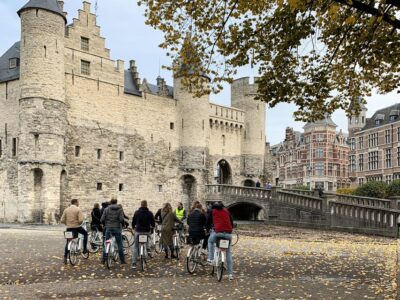

Guided Bike Tour: 2 Hours Highlights of Antwerp
Read our review →

Browse the lists this tour appears in